Showing posts with label undated. Show all posts

5.24.2014

1964: Blue-eyed soul

"Blue-eyed soul" refers to soul and R&B music performed and sung by white musicians. The term first came into play during the mid-'60s, when acts like The Righteous Brothers had hits with soulful songs like "You've Lost That Lovin' Feelin'." Throughout the late '60s, blue-eyed soul thrived, as acts like The Rascals, The Box Tops, Mitch Ryder, Tony Joe White and Roy Head had a series of hits.
     -- From "All Music Guide to Soul" (2003)

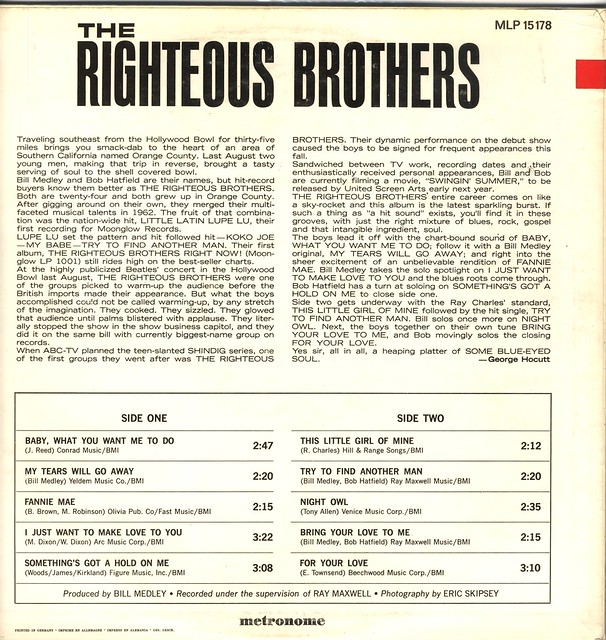
Note: Philadelphia DJ Georgie Woods is generally credited with popularizing the term "blue-eyed soul" in 1964, specifically in describing The Righteous Brothers and their hit "You've Lost That Lovin' Feelin'." That song, released in December 1964, reached No. 1 on the Billboard charts in February 1965. (Also in December 1964, The Righteous Brothers released the album "Some Blue-Eyed Soul," though it did not include "Lovin' Feelin'.") 


Bill Medley of The Righteous Brothers writes in his memoir "The Time of My Life" that the term dates back a little earlier, to the duo's song "Little Latin Lupe Lu" from 1963. "We were enough of a hit that Atlantic Records, led by the legendary Ahmet Ertegun, picked up the national distribution rights for "Lupe Lu" and that's where the term 'blue-eyed soul' really came from. Atlantic was pretty much an all-black R&B label. When their public relations guy Red Schwartz took us out to promote it on radio stations, we found that most of them were black stations. In those days, radio was really divided like that. Unfortunately, Atlantic forgot to mention that we were white. When we showed up to do interviews, they were stunned. They'd still do the interview, but when we left, they'd quit playing the record. It wasn't a racial thing. It was like 'we play black artists.' ... Of course when 'Lovin' Feelin' came around, they said, 'Screw it, these guys are black. They're black enough.' One DJ in Philadelphia started saying, 'Here's my blue-eyed soul brothers.' In the 1950s and 1960s black guys would use the term 'blue-eye' to refer to a white guy. He was hipping his audience to the fact that we were two white guys. It was like a secret code and it caught on."
* Entry from "All Music Guide to Rock" (2002): @
* Back cover of "Some Blue-Eyed Soul": @
* Hot Rhythm & Blues Singles (Billboard magazine, February 6, 1965): @
* "R&B Stations Open Airplay Gates to 'Blue-Eyed Soulists' " (Billboard, October 9, 1965): @
* "Blue-Eyed Soul Artists Herald Musical Integration on Airways" (Billboard, April 2, 1966): @
* Georgie Woods biography (from The Broadcast Pioneers of Philadelphia): @
* Woods biography (from The Living Legends Foundation): @
* "Joy Ride! The Stars and Stories of Philly's Famous Uptown Theater" (Kimberly C. Roberts, 2013): @
* WDAS history: @ 

9.19.2013

Undated: Record players for cars

The quest continues for a skip-free record player for cars, though the feature had been offered (and then dropped) by Chrysler in the late '50s-early '60s. This is from the October 1963 issue of Popular Science magazine (complete issue: @).


* "Chrysler Corp. takes customers for a spin" (from www.uaw-chrysler.com): @
* "Hi Fi Record Players Now Made for Cars" (St. Petersburg Times, September 18, 1955): @
* "Highway Hi-Fi" (by Peter C. Goldmark, who developed the device; Audio magazine, December 1955): @
 * Highway Hi-Fi pages from ImperialClub.com: @ and @
* "Road Tunes: Weird Vintage 1950s In-Car Record Players" (from gajitz.com): @
* Entry from automotive oddity website (www.roadkillontheweb.com): @
* Video of player in 1960 Chrysler Imperial LeBaron: @
* "Rhythms for the Highway, Before the Age of the iPod" (New York Times, June 8, 2012): @

6.28.2013

1963: Origin of chicken nuggets

In 1963, (Cornell University professor Robert C.) Baker and his colleague Joseph Marshall proposed a first-ever "chicken stick," made of ground, blended and frozen chicken. Keeping the stick together without a sausage-like skin, and keeping the breading on through freezing and frying, were major advances.
     -- From "The Lost History and Unintended Consequences of the Chicken Nugget" (Maryn McKenna, wired.com, 2012; full story: @)

* "The Father of the Chicken Nugget" (Slate, 2012): @
* "The invention of the Chicken McNugget" (www.marketplace.org, 2013): @
* Baker obituary (New York Times, 2006): @
* "How 'Barbecue Bob' Baker Transformed Chicken" (Cornell University, 2012): @
* "Generations & Innovations, Robert C. Baker '43" (Cornell, 2013): @ 

1.19.2013

Undated: Vidal Sassoon's bob haircut

British hairdresser Vidal Sassoon updates and popularizes the bob haircut, most notably in his work with fashion designer Mary Quant and with actress Nancy Kwan (for the movie "A Wild Affair"). 

Photo of Sassoon and Quant, 1964.
* BBC documentary (2011): @
* Sasson explains the Five-Point Cut: @
* "Remembering Vidal Sassoon" (from Vogue.com): @
* Photo gallery (from Vogue.com UK): @
* Photo gallery (from Telegraph newspaper): @
* "After Vidal Sassoon Britain never looked the same again" (Telegraph, 2012): @
* "Vidal Sassoon remembered by Mary Quant" (The Guardian, 2012): @
* Mary Quant website: @ 
* "Vidal" (Pan Macmillan, 2010): @
* "The Bob: the history of a hairstyle" (from V is for Vintage): @
* "Encyclopedia of Hair: A Cultural History" (Victoria Sherrow, 2006): @ 

1.15.2013

Undated: Corvette Sting Ray

The fast, futuristic sports car -- from the Chevrolet division of General Motors -- is a road-hugging, attention-grabbing hit. First introduced in 1962 (for the 1963 model year), it was described this way in press releases:

Corvette has been redesigned and re-engineered for the first time in its 10 years on the market. Added to the convertible is a new "fast-back" sport couple. Optional power steering, power brakes and air conditioning are available for the first time. A completely new chassis, four-wheel independent suspension, self-adjusting brakes and improved steering are features of 1963's Corvette. Retractable headlights are standard on both models. Corvette models are known as "Sting Ray." This year's Corvette is two inches lower and four inches shorter than last year.
* Entry from web-cars.com: @
* Entry from www.ultimatecarpage.com: @
* www.corvetteforum.com: @
* From Car and Driver magazine (April 1963): @
* "Biography of a Sports Car" (GM video): @
* TV ads: @ and @
* "Luxury Prestige Personal Car is Sign of the Affluent American" (Associated Press, March 1963): @
* "The Complete Corvette: A Model-By-Model History of the American Sports Car" (Tom Falconer, 2003): @ 

12.21.2012

Undated: 'The whole nine yards'

The exact origin of the phrase (meaning "everything that is pertinent, appropriate or available") remains a mystery, but it shows up in print at least twice in late 1962: first in a short story, and then in a letter to a car magazine.

* From www.visualthesaurus.com: @ and @
* From www.worldwidewords.org: @
* From www.phrases.org.uk: @
* From www.barrypopik.com: @ 

11.02.2012

November 1962: 'Personal computer'

From a November 2 story by The Associated Press:

   WASHINGTON -- Pocket-size computers may eliminate the housewife's weekly shopping list. Electronic communication would tell the store in advance what she needed. She would simply pick up the bundles.
   This was envisioned today by Dr. John W. Mauchly, inventor of some of the original room-size computers, who has developed one the size of a suitcase and is now working on a pocket variety.
   Dr. Mauchly, here to address a meeting of the American Institute of Industrial Engineers, said that in a decade or so everyone would have his own computer. Data pertinent to the individual and his problems would be stored in the computers' wafer-thin memory cells. ...
   The inventor's original computers weighed nearly 30 tons and occupied 15,000 feet of floor space. His latest is a portable 50-pound one of suitcase size.
   The present emphasis on miniaturizing components of missile and spacecraft will inevitably result in developing small, inexpensive computers within the financial reach of almost everyone, Dr. Mauchly said.
   "There is no reason to suppose the average boy or girl cannot be master of a personal computer," he said.
* Mauchly entry from National Inventors Hall of Fame: @
* "John W. Mauchly and the Development of the ENIAC computer" (University of Pennsylvania): @
* Mauchly biography (University of St. Andrews, Scotland): @

9.10.2012

1962: Ronald Reagan switches parties


Campaigning for Richard Nixon, who was running for the governorship of California, Reagan changes his political registration from Democrat to Republican. The move had been some time in coming, as Reagan had grown increasingly disenchanted with Democratic Party policies, particularly in regards to the size and scope of the federal government. (Reagan had also helped lead the Southern California Democrats for Nixon during the 1960 presidential campaign; "This is no longer the Democratic Party I joined as a young man," he said at the time.)

From Reagan's book "An American Life" (1990):

I spoke to a Republican fund-raising event near my home in Pacific Palisades and a woman in the audience stood up in the middle of my speech and asked me: "Have you reregistered as a Republican yet?"
"Well, no, I haven't yet," I said, "but I intend to."
"I'm a registrar," she said, and walked down the center aisle through the audience and placed a registration form in front of me. I signed it and became a Republican, then said to the audience, "Now, where was I?"

The Ronald Reagan Presidential Foundation and Library says this took place in the fall of 1962.

Note: Over the years, Reagan would be quoted as saying "I didn't leave the Democratic Party; the Democratic Party left me." That famous line echoes Nixon's acceptance speech at the 1960 Republican National Convention: "And in this campaign I make a prediction. I say that just as in 1952 and 1956 millions of Democrats will join us -- not because they are deserting their party, but because their party deserted them at Los Angeles two weeks ago."

1965 photo of Nixon, Reagan and Barry Goldwater from The Phoenix Gazette.

* "How Reagan Became Reagan" (Steven F. Hayward, Claremont Review of Books, fall 2004): @
* "The Education of Ronald Reagan: The General Electric Years and the Untold Story of His Conversion to Conservatism" (Thomas W. Evans, 2008): @ 
* "Life Before the Presidency" (Miller Center, University of Virginia): @
* "Encroaching Control" (Reagan speech from 1961): @ 

7.18.2012

Undated: 'Little Boxes'

Written by Malvina Reynolds, the song mocks suburban development and residents; Reynolds wrote the song after driving through Daly City, California, just south of San Francisco. A version by Pete Seeger would reach No. 70 on Billboard's Hot 100 music charts in February 1964. The term "ticky-tacky" -- in the context of the song, meaning low-quality building materials used for standardized housing -- also entered the language (and dictionaries).

Photo by Rondal Partridge ("Housing, Daly City, California, late 1960s"). More of Partridge's work: @ and @

* Entry from "Malvina Reynolds: Song Lyrics and Poems": @
* Lyrics as published in Broadside magazine (February 1963, PDF): @
* Remembrance of Reynolds by her daughter: @
* History of Daly City: @

7.15.2012

Undated: Thalidomide in the U.S.

Public awareness about thalidomide increases dramatically, with news reports and congressional hearings about the drug's risks: that expectant mothers taking the sedative might give birth to deformed babies. (Thalidomide sales had already been halted throughout Europe.)

July 15: The Washington Post publishes a front-page story about thalidomide, largely about the efforts of Dr. Frances Oldham Kelsey of the Food and Drug Administration, who worked to prevent her agency from approving the drug for use in the United States. Other news outlets quickly follow up on Morton Mintz's reporting.
* Text of story: @
* "Morton Mintz on the collapse of Congressional oversight" (from www.neimanwatchdog.org): @
* 2012 interview with Mintz: @

July 30: The FDA provides details on thalidomide distribution. From The New York Times: "A total of 1,229 physicians in thirty-nine states and the District of Columbia and one in Canada received test samples of thalidomide, a drug blamed for thousands of birth defects in Europe. ... It has been estimated by Government officials that hundreds or perhaps thousands of Americans were given the drug on an experimental basis. ... A drug concern may make arrangements with doctors for the experimental use of a new drug without Federal approval. The law merely requires that the company keep a record of the shipments and that they be labeled 'caution, new drug limited by Federal law to investigate use.' This was the procedure used by the W.S. Merrell Company of Cincinnati, a reputable drug concern that held exclusive United States rights to distribute thalidomide. The company notified physicians last March to cease giving the drug."

Later estimates indicate that about 2.5 million samples were given out to some 20,000 patients.

August: Dr. Helen Taussig's "The Thalidomide Syndrome" is published in Scientific American. The report provides a history of the drug, discusses its effects on fetuses, and includes Taussig's observations in West Germany, where thalidomide (brand name Contergan) had been much more widely used. She writes: "The one-third who are so deformed that they die may be the luckier ones."
* Profile of Taussig (from National Library of Medicine): @

August 1: President Kennedy opens his press conference with a statement about thalidomide and pending drug legislation. In answer to a follow-up question, Kennedy says, "Every woman in this country, I think, must be aware that it is most important that they check their medicine cabinet, that they do not take this drug, that they turn it in."
* Text: @
* Audio: @

August 7: President Kennedy awards Dr. Kelsey the President's Award for Distinguished Federal Civilian Service.
* Kennedy's remarks (from www.jfklink.com): @
* 1957 executive order creating the award (from archives.gov): @

August 10: Life magazine's cover story carries this headline: "The Full Story of the Drug Thalidomide / The 5,000 Deformed Babies ... The Woman Who Saved Thousands ... The Moral Questions of Abortion and Euthenasia." The article includes the warning box at left and the story of an Arizona woman, Sherri Finkbine, who went to Sweden for an abortion rather than bear the child, which after the operation was found to be severely deformed. (Finkbine had the abortion on August 18).
* Text of Life magazine story: @

In October, Congress would pass, and Kennedy would sign, legislation that strengthened the rules for drug safety and required manufacturers to prove their drugs' effectiveness.

-----------

* "Dark Remedy: The Impact of Thalidomide and Its Revival as a Vital Medicine" (Trent D. Stephens and Rock Brynner, 2001): @
* "Protecting America's Health: The FDA, Business, and One Hundred Years of Regulation" (Philip J. Hilts, 2004): @
* "Reputation and Power: Organizational Image and Pharmaceutical Regulation at the FDA" (Daniel P. Carpenter, 2010): @
* "Thalidomide Crisis & Drug Regulation" (exhibit at Emory Libraries, Atlanta, Georgia): @
* "Thalidomide and Political Engagement in the United States and West Germany" (from Social History of Medicine, 2002): @
* "Congressman's Report" (from Arizona Rep. Morris K. Udall, August 17, 1962): @

Previous posts about thalidomide:
* William S. Merrell Co. submits drug application (September 8, 1960): @
* Letter in The Lancet raises concerns (December 16, 1961): @

4.24.2012

Undated: Barbie's Dream House

Mattel begins selling the cardboard fold-up house -- one room, complete with a closet, record albums and a photo of Ken. A print advertisement reads: Here's where Barbie lives! Her house comes with a convenient carrying handle, includes a complete suite of easy-to-assemble, modern, slim-line furniture and all the special living accessories Barbie has chosen for her home. Folds away neatly and compactly when not in use. $8.00 (Slightly higher west of the Rockies)

* Photos of this and other Barbie houses: @
* TV commercial: @
* Earlier post on introduction of Ken doll (March 1961): @

4.17.2012

Undated: '1975: And The Changes to Come'

What's on Delhi-Television Tonight? This is the ultimate in proposed television sets for a decade hence. It can receive television signals bounced from circling satellites, bringing programs from any city on the globe. The spot of origin of the program is indicated by a light on the world map in the upper panels. Round dials are clocks showing the hour in four major time zones. Dials at right are for tuning and sound control. The set is only three inches thick. On the reverse side it is equipped with an international stereophonic radio.

That's among the predictions in "1975: And the Changes to Come," a book by Arnold B. Barach, a senior editor at Changing Times magazine. From an ad for the book in the March 1962 issue of Changing Times (later known as Kiplinger's Personal Finance):

A dramatic forecast of life in 1975, based on what's actually being developed today, and including a list of suggested investments in industries and companies most likely to prosper in the years ahead. A profusely illustrated and detailed expansion of a study originally presented in the January 1961 edition of Changing Times. More than 140 photographs and drawings of what's to come ... including charts showing business and economic growth, population increases, employment, college enrollment, and the coming shortage of doctors. ... You'll enjoy and profit from this fascinating preview of YOUR future.

Image provided by Derrick Bostrom; more selections from the book here: @

* January 1961 issue of Changing Times: @

4.09.2012

Undated: Harvard Psilocybin Project


Headed by Timothy Leary and Richard Alpert of Harvard's Department of Psychology, the project ends its work amid concerns by other faculty members and investigations by authorities into the use (or suspected misuse) of psilocybin. As part of Leary's and Alpert's research, psychedelics had been administered to students and prisoners.
* Entry from Harvard's psychology department: @

* "The Strange Case of the Harvard Drug Scandal" (Look magazine, November 5, 1963): @
* Letter from Leary and Alpert to Harvard Crimson (December 13, 1962): @
* "Timothy Leary and Havard, Reunited At Last" (from Timothy Leary Archives): @
* "Dr. Leary's Concord Prison Experiment: A 34-Year Follow-Up Study" (from Journal of Psychoactive Drugs, 1998): @ and @
* "The Good Friday Marsh Chapel Experiment" (1994, St. Petersburg Times): @
* The Harvard Psychedelic Club: How Timothy Leary, Ram Dass, Huston Smith, and Andrew Weil Killed the Fifties and Ushered in a New Age for America" (2011 book by Don Lattin): @
* Talk by Lattin (from www.c-spanvideo.org): @
* "Acid Dreams: The Complete Social History of LSD: The CIA, the Sixties, and Beyond" (1992 book by Martin A. Lee and Bruce Shlain): @
* "Storming Heaven: LSD & The American Dream" (1998 book by Jay Stevens): @
* Earlier post on Leary (August 9, 1960): @
* Earlier post on Leary (August 18, 1961): @

3.28.2012

Undated: Miss Army Recruiting of 1962

Actress Jane Fonda is given the honorary title by the Pentagon, and speaks in Washington on behalf of the U.S. military.

The picture, credited to UPI Telephoto, would resurface a decade later. From the July 4, 1972 edition of The Lima (Ohio) News: "FROM JANE'S PAST -- Anti-war groups would be hard put to recognize one of their most staunch advocates, shown in this 1962 Army photograph. Bearing the title of "Miss Army Recruiting -- 1962" is none other than actress Jane Fonda, known today as an anti-war militant. With Patterson, N.J., recruiter Sgt. Robert Juhren, Miss Fonda was making radio spots about what a good idea joining the Army was. The photo was found by the Overseas Weekly newspaper in a 10-year-old edition of the Casemate, a Ft. Monroe, Va., post paper. Times have changed for the Army and for Miss Fonda."

Note: Some references, including Fonda's 2005 autobiography "My Life So Far," give the year as 1959.

* Excerpt from "Jane Fonda: The Private Life of a Public Woman" (2011 book by Patricia Bosworth): @ 

3.26.2012

Undated: Elephant patrol in Vietnam


This photo, taken by Howard Sochurek, appears in the March 16 issue of Life magazine. The caption reads: "On the gently heaving backs of four bull elephants, a Vietnamese army patrol starts out into the hilly jungles of central South Vietnam, their weapons at the ready. For generations, warriors in the region rode to battle this way, and both the government and their enemy still use the huge beasts. A man on foot can cover not much more than three miles a day through the dense undergrowth and an elephant can do four times that. But the archaic scene belies the true nature of Vietnam's savage war. Somewhere ahead of the elephant patrol, the odds are strong that enemy guerrillas with deadly modern arms wait in ambush."

* "War Elephants" (2007 book by John M. Kistler, Richard Lair): @
* Audio interview with Kistler: @
* "War Elephants" (2008 book by Konstantin Nossov): @

3.20.2012

Undated: Book vending machines


With such names as "Vend-A-Book," "Read-O-Mat" and "Book-O-Mat," vending machines that dispense books are highly touted but only mildly popular.

From the December 1962 edition of Library Journal: "It was inevitable that someone would think of it, and now it is here. A paperback vending machine has just been introduced, and it has exciting possibilities for libraries. True, it sells paperback books, two characteristics that may decrease its appeal for some libraries; but the U.S. in 1962 is an affluent society where very few of the adults using a library cannot afford the price of a paperback -- often less than the cost of a hamburger and coffee."

The concept was not a new one (and it continues to this day). English publisher Richard Carlile came up with the first book vending machine in the 1820s (specifically to sell Thomas Paine's "The Age of Reason"), and in the 1930s, Penguin Books installed a book dispenser in London, called the Penguincubator. The late 1940s also saw increased promotion and interest.

* Excerpt from "Vending Machines: An American Social History" (book by Kerry Segrave): @
* "Paperback promotionals" (from Paperback Quarterly, 1979): @

* "Old, Weird Tech: The Penguincubator, A Book Vending Machine" (from theatlantic.com, 2011): @

* "Book Publishers Eyeing Venders as Sales Decline" (from The Billboard magazine, February 28, 1948): @
* "Book Machines Get Williams Into Vending" (from Billboard Music Week, October 27, 1962): @

3.09.2012

Undated: 'Child with a toy hand grenade in Central Park'

The essence and lasting impact of this photo, taken by Diane Arbus in the spring or summer of 1962, as described by the Heilbrunn Timeline of Art History (New York's Metropolitan Museum of Art):

"An iconic image that embodies the awkward tension between childhood tomfoolery and primal violence, this has become one of the most celebrated photographs in the history of the medium. America's historic transition from the complacent isolationism of the 1950s to the sociopolitical turmoil that would emerge in the late 1960s and 1970s seems to seethe beneath the surface of this image, underscoring Arbus' prescience and intuitive understanding of her time."

* Contact sheet: @
* "Post-developments" (article about Colin Wood, the boy in the photo; San Francisco Chronicle, 2003): @
* More photos by Arbus (from diane-arbus-photography.com): @
* Arbus biography (from masters-of-photography.com): @
* Arbus biography (from www.jewishvirtuallibrary.com): @
* Explaining Arbus' work (from www.haberarts.com): @
* "A Fresh Look at Diane Arbus" (Smithsonian magazine, 2004): @
* "Double Exposure" (The Washington Post, 2005): @

3.07.2012

Undated: Tax deduction for clarinets

A tax deduction that remains applicable to this day (from TurboTax, http://turbotax.intuit.com):

Does Your Child Have an Overbite?
If so, you might want to enroll them in clarinet lessons. Both the clarinet and music lessons are tax deductible thanks to a 1962 provision added after orthodontists argued that playing the clarinet helps with a child's overbite and thus may qualify as a medical expense.

The IRS ruling (Rev. Rul. 62-210, 1962-2 C.B. 89, text from www.charitableplanning.com):

The taxpayer's son has a congenital defect which results in a severe malocclusion of his teeth. An orthodontist recommended that the child take lessons in playing a clarinet, as he considered continued practice with this instrument therapeutic treatment towards alleviating the specific condition. Held, an amount which does not exceed the minimum cost of a clarinet of a quality sufficient to give effect to the therapeutic treatment recommended by the orthodontist and the cost of lessons necessary for the son to play the instrument to the degree required to obtain the benefits of the treatment may qualify as medical expenses within the meaning of section 213 of the Internal Revenue Code of 1954. Such amounts paid are deductible by the taxpayer to the extent provided in that section.

3.05.2012

Undated: 'Freedom and You' (aka 'Red Nightmare')

Made by Warner Brothers studio for the U.S. Department of Defense, "Freedom and You" was an hourlong propaganda film intended for viewing by military personnel. It was later shortened, retitled as "Red Nightmare" and shown on American television and in U.S. schools. It tells the story of a disinterested citizen who wakes up to a Communist-controlled society. Because of Warner Brothers' involvement, it had many more familiar faces than a typical propaganda movie -- Jack Webb (of TV's "Dragnet") was the narrator, and Jack Kelly (from TV's "Maverick") played the title character.

* Watch "Freedom and You" (from the Internet Archive):
@
* Watch "Red Nightmare" (also from the Internet Archive): @
* Summary from www.conelrad.com: @
* Summary from Peter Brown fan site: @
* " 'Red Nightmare': Asleep with the Defense Department" (1975 article from Jump Cut: A Review of Contemporary Media): @
* Similarities between film and TV series "The Prisoner": @

Blog archive

Twitter

Follow: @