Showing posts with label religion. Show all posts

1.14.2017

Saturday, January 14, 1967: 'Human Be-In'


SAN FRANCISCO -- Anybody who was nobody was there.
     And if there were any anybodys, nobody knew.
     It was the city's biggest social event of the season but it failed to make the society pages.
     It was a happening.
     It took place Saturday at the polo field in Golden Gate Park. They were all there -- the hippy denizens of the Haight-Asbury District and outlying regions, the activists from Berkeley, the Hells Angles, students, beatniks, toddlers. Thirteen thousand of them under a sunny sky.
     And about 2,000 spectators, some of them bemused, some completely dumbfounded. The police also sent a delegation, mainly to ticket dozens of illegally parked cars.
     Word of the event began circulating earlier this month in the Haight-Asbury, home for many of the city's far-out types. It was billed as a "human Be-In" and a "Gathering of the Tribes," a get-together for political activists and hippies. The public was also invited and asked to bring "costumes, blankets, bells, flags, symbols, drums, beads, feathers and flowers."
     -- Story by United Press International
     -- Photo by Ted Streshinsky

* "Reliving the Human Be-In 50 Years Later" (San Francisco Chronicle, January 2017): @
* Summary from California Historical Society: @
* Description from Peter Coyote: @
* "Human Be-In in San Francisco 1967" (The Allen Ginsberg Project, July 2011): @
* "The Human Be-In" (Helen Perry, 1970): @
* "The Beginning is the Human Be-In" (Berkeley Barb, January 6, 1967): @
* "What Happened at the Hippening" (Berkeley Barb, January 20, 1967): @
* Footage: @ and @
* Photos by Larry Kennan: @
* Poster (Oakland Museum of California): @ 

8.05.2016

August 1966: The Beatles

"Revolver"
     The album was released on August 5 in Britain and August 8 in the United States.
* Summary from www.thebeatles.com: @
* Summary from The Beatles Bible: @
* "UK Album Release" (The Beatles Bible): @
* "U.S. Album Release" (The Beatles Bible): @
* "The Beatles: U.S. vs. UK Album Guide" (Ultimate Classic Rock): @
* Album review (Kevin Courrier, Critics At Large): @
* Album review (Scott Plagenhoef, Pitchfork): @
* "Classic Album Dissection" ("Sound Opinions," 2006): @
* "The Kinks vs. The Beatles: Ray Davies Thought 'Revolver' was Garbage" (dangerousminds.net): @
* "How I drew a pop art masterpiece for the Beatles" (The Guardian, 2016): @
* " 'Revolver': How the Beatles Reimagined Rock 'n' Roll" (Robert Rodriguez, 2012): @

"We're more popular than Jesus now"
* Post from March 4, 1966, when the story was originally published in the London Evening Standard: @

Candlestick Park, San Francisco
     The band's August 29 show marked their last live performance until their rooftop concert in London on January 30, 1969.
* Summary from The Beatles Bible: @
* "The Beatles at Candlestick in 1966: An oral history from the fans" (San Francisco Chronicle, 2014): @
* "Listen to cassette recording of The Beatles' final concert at Candlestick Park" (Consequence of Sound): @ 

4.07.2016

Friday, April 8, 1966: 'Is God Dead?'


Time magazine publishes a provocative article (with a controversial cover) by religion editor John T. Elson. It begins:

TOWARD A HIDDEN GOD
     Is God dead? It is a question that tantalizes both believers, who perhaps secretly fear that he is, and atheists, who possibly suspect that the answer is no. 
     Is God dead? The three words represent a summons to reflect on the meaning of existence. No longer is the question the taunting jest of skeptics for whom unbelief is the test of wisdom and for whom Nietzsche is the prophet who gave the right answer a century ago. Even within Christianity, now confidently renewing itself in spirit as well as form, a small band of radical theologians has seriously argued that the churches must accept the fact of God's death, and get along without him. How does the issue differ from the age-old assertion that God does not and never did exist? Nietzsche's thesis was that striving, self-centered man had killed God, and that settled that. The current death-of-God group believes that God is indeed absolutely dead, but proposes to carry on and write an theology without theos, without God. Less radical Christian thinkers hold that at the very least God in the image of man, God sitting in heaven, is dead, and -- in the central task of religion today -- they seek to imagine and define a God who can touch men's emotions and engage men's minds. 
     If nothing else, the Christian atheists are waking the churches to the brutal reality that the basic premise of faith -- the existence of a personal God, who created the world and sustains it with his love -- is now subject to profound attack.

* Complete text: @
* "Is God Dead?" (the Rev. G.H. Ashworth, for The Bryan, Ohio, Democrat, May 25, 1905): @
* "The God Is Dead Movement" (Time, October 22, 1965; subscription only): @
* John T. Elson obituary (New York Times, 2009): @
* "Is God Just a Human Invention? And Seventeen Other Questions Raised by the New Atheists" (Sean McDowell and Jonathan Morrow, editors, 2010): @
* "Methodist Heretic: Thomas Altizer and the Death of God at Emory University" (Christopher Demuth Rodkey, 2010): @
* "American Nietzsche: A History of an Icon and His Ideas" (Jennifer Ratner-Rosenhagen, 2012): @
* " 'God Is Dead' Controversy" (New Georgia Encyclopedia, 2013): @
* "Thomas J.J. Alitzer: On the Death of God Theology" (Jose L. Gutierrez, 2014): @

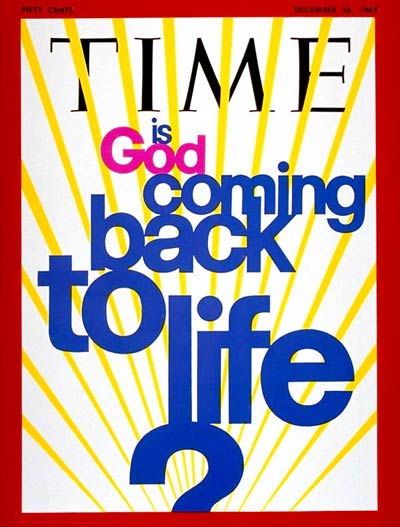
Time, December 26, 1969
The magazine publishes a three-year-later look at the subject with "The New Ministry: Bringing God Back to Life."
* Text (subscription only): @

motive magazine, February 1966
The official magazine of the Methodist Student Movement publishes a satirical obituary, written in the style of The New York Times, titled "God is Dead in Georgia."
* Complete text: @
* Note: Anthony Towne, who wrote the obituary, followed it up in 1968 with the book "Excerpts from the Diaries of the Late God." Short summary (from "Religion in America Since 1945: A History," Patrick Allitt, 2003): @
* motive magazine archives (Boston University School of Theology): @ and @

Sojourner Truth, 1852
During an anti-slavery meeting in Salem, Ohio, the abolitionist and social reformer replies to Frederick Douglass' speech on how to rid the country of slavery with the plaintive question (by some accounts), "Is God gone?" The phrase is more remembered as "Is God dead?", which is also inscribed -- without the question mark -- on her tombstone in Battle Creek, Michigan.
* Excerpt from "Sojourner Truth: Slave, Prophet, Legend" (Carleton Mabee and Susan Mabee Newhouse, 1995): @
* Exceprt from "Sojourner Truth as Orator: Wit, Story and Song" (Suzanne Pullon Fitch and Roseann M. Mandzuik, 1997): @
* Excerpt from "Sojourner Truth's America" (Margaret Washington, 2009): @ 

3.04.2016

Friday, March 4, 1966: 'We're more popular than Jesus now'


In a story written by Maureen Cleave and published in the London Evening Standard, John Lennon of The Beatles says:

Christianity will go. It will vanish and shrink. I needn't argue about that; I'm right and I will be proved right. We're more popular than Jesus now; I don't know which will go first -- rock 'n' roll or Christianity. Jesus was all right but his disciples were thick and ordinary. It's them twisting it ruins it for me.

Lennon's comments attracted little attention until they were reprinted in the September edition of Datebook magazine. (The cover and inside headline used the phrase "I don't know which will go first -- rocknroll or Christianity.") 


The backlash in the United States was swift, beginning with radio station WAQY in Birmingham, Alabama, which in August encouraged listeners to throw away or burn the band's records. Other stations followed suit and stopped playing Beatles songs, while the group was condemned by politicians and religious figures.


-- Jackson, Mississippi, August 1966; photo by Corbis Images

* March 4 summary from The Beatles Bible: @
* July 29 summary from The Beatles Bible: @
* Summary from The Beatles Ultimate Experience: @
* "John Lennon and Jesus, 4 March 1966" (Gordon Thompson, author of "Please Please Me: Sixties British Pop, Inside Out"): @
* " 'Christianity will go' comment stirs up fans" (Ottawa Citizen, August 3, 1966): @
* "John's Gospel" (David Frost, The Spectator, August 12): @
* "Beatle Lennon Apologizes" (The Nashua, N.H., Telegraph, August 12): @
* "Stations No, No Beatles Disks" (Billboard, August 13): @
* "Beatles Running Strong -- With Powerhouse Stations' Blessings" (Billboard, August 20): @
* "Warm Welcome for Beatles in 'Bible Belt' " (Sydney Morning Herald, August 21): @
* "Vatican 'forgives' John Lennon" (Reuters, November 22, 2008): @
* Film clips of controversy: @ 

12.09.2015

Thursday, December 9, 1965: 'A Charlie Brown Christmas'


Even Christmas threatens to add a bit of "good grief" to the worrisome world of Charlie Brown when the wispy-haired youngster and his "Peanuts" friends, favorites of millions of comic-strip readers throughout the world, make their debut as stars of a television special in "A Charlie Brown Christmas," animated-cartoon presentation in color Thursday, Dec. 9 on the CBS television network (7:30-8:00 pm).
     -- from Nashua (N.H.) Telegraph, December 3, 1965: @
     -- Image from The Vernon (Texas) Daily Record, December 8

* TV Guide, December 9, 1965: @
* Reviews by Associated Press (Cynthia Lowry) and United Press International (Rick DuBrow): @
* " 'A Charlie Brown Christmas': The Making of a Tradition" (Lee Mendelson and Bill Melendez, 2000): @
* "A Charlie Brown Religion: Exploring the Spiritual Life and Work of Charles M. Schulz" (Stephen J. Lind, 2015): @ 

10.28.2015

Thursday, October 28, 1965: Nostra Aetate


Pope Paul and the Vatican ecumenical council Thursday decreed massive changes for the entire structure of Roman Catholicism. They proclaimed a new and unbiased friendship for Jews and other non-Christians. ... The new decrees oblige Catholics to do unprejudiced thinking and dealing with Jews and others outside Christianity after 2,000 years of turbulent history. ... The documents: Insist that the entire Jewish people cannot be charged with Christ's Crucifixion or depicted as accursed by God; pay respect to Islam and other non-Christian religions and reject any kind of discrimination.
     -- Associated Press: @

* "Declaration on the Relation of the Church to Non-Christian Religions: Nostra Aetate" (Pope Paul VI,  1965): @
* Summary from Berkley Center for Religion, Peace & World Affairs: @
* "Nostra Aetate: What Is It?" (Anti-Defamation League): @
* "Guidelines and Suggestions for Implementing the Conciliar Declaration 'Nostra Aetate' " Commission for Religious Relations with the Jews, 1974): @
* "Notes on the correct way to present the Jews and Judaism in preaching and catechesis in the Roman Catholic Church" (Commission for Religious Relations with the Jews): @
* " 'Nostra Aetate,' Forty Years After Vatican II; Present & Future Perspectives" (Commission for Religious Relations with the Jews, 2005): @
* Related resources (Council of Centers on Jewish-Christian Relations): @
* Related resources (JesuitResource.org, Xavier University): @
* "No Religion Is An Island: The Nostra Aetate Dialogues" (1998): @
* "Nostra Aetate: Origins, Promulgation, Impact on Jewish-Catholic Relations" (2007): @ 
* "Stepping Stones to Other Religions: A Christian Theology of Inter-religious Dialogue" (Dermot A. Lane, 2011): @
* "Interreligious Friendship After Nostra Aetate" (2015): @

3.15.2015

Monday, March 15, 1965: LBJ and MLK speeches


WASHINGTON -- President Johnson took the rallying cry of American Negroes into Congress and millions of American homes tonight by pledging that "we shall overcome" what he called "a crippling legacy of bigotry and injustice." In his slow Southern accent, Mr. Johnson demanded immediate action on legislation designed to remove every barrier of discrimination against citizens trying to register and vote.
     -- Story by The New York Times: @
     -- Photo by Cecil Stoughton

* Video and transcript (from LBJ Library): @


At Brown Chapel AME in Selma, Alabama, the Rev. Martin Luther King Jr. speaks at an interfaith service for the Rev. James Reeb, who died March 11 from a beating two days earlier.
     -- Photo by Flip Schulke

* Audio (from www.uuworld.org): @
* Transcript (www.beaconbroadside.com): @ 

10.13.2014

October 1964: 'If I Were the Devil'

Radio/newspaper commentator Paul Harvey's famous column appears in newspapers throughout the United States. Harvey describes what actions Satan would take to reign over civilization, at the end revealing that all the events are already taking place.
     Note: The column's earliest appearance in a newspaper is October 1964, but the book "Good Day!" (linked below) dates the piece to 1960. Harvey also read the piece as part of his radio broadcast.

* 1964 column: @
* 1996 version: @
* Entry from snopes.com: @
* Harvey biography from Encyclopedia of Oklahoma History & Culture: @
* Harvey biography from Radio Hall of Fame: @
* "Good Day!: The Paul Harvey Story" (Paul J. Batura, 2009): @ 

2.25.2014

Tuesday, February 25, 1964: Cassius Clay


Jabbing, jabbering Cassius Clay ruled as heavyweight champion of the world today in an unbelievable upset at Miami Beach because of one punch -- and he didn't even throw it. Sonny Liston, the supposedly unconquerable "killer," threw the punch and when it missed the follow-through, twisted a tendon in his massive left shoulder.
     -- The Miami News (link: @)

Tuesday night was the night that was for Cassius Clay. He became heavyweight boxing champion of the world -- just like he said he would. He didn't do it so much with his fists, or his fast talk for which he is noted, but with an "injury" to his opponent, Charles "Sonny" Liston. 
     -- United Press International (link: @)

Cassius Clay, a 7-1 longshot, scored one of the major upsets in boxing history Tuesday night when Sonny Liston gave up the world heavyweight title in his corner because of a strained left shoulder.
     -- Associated Press (link: @)

Incredibly, the loud-mouthed bragging, insulting youngster had been telling the truth all along. Cassius Clay won the world heavyweight title tonight when a bleeding Sonny Liston, his left shoulder injured, was unable to answer the bell for the seventh round.
     -- The New York Times (link to PDF: @)

Like the Lord High Executioner getting ready for another payday, Sonny Liston fixed a fresh victim with his famous full-whammy stare. Cassius Clay didn't pay much attention. Taunting, jabbing and above all, staying out of range of the champ's left hook, Clay simply kept his mind on proving that, as he had so often noted, "I am the greatest!"
     -- Life magazine (March 6; link: @)

There is no terror, Cassius, in your threats.
-- Julius Caesar, Act IV, Scene 3
     But there was. In Miami Beach last week, Cassius Marcellus Clay Jr. acted out a scene that was worthy of the Old Bard himself -- or maybe P.T. Barnum. Just as he said he would, he took the heavyweight championship of the world away from Charles ("Sonny") Liston, thereby proving that the mouth is faster than the eye.
     -- Time magazine (March 6; subscription-only link: @)

It was, no matter what you have read or heard, an enormously exciting fight. It matched the classic contenders for a heavyweight championship of the world -- a beautiful, controlled boxer against a man who could hit with deadly power. The fight -- Clay against Liston -- restored balance and intelligence to the concept of boxing. The boxer, using his skills with aplomb and courage and forethought, confounded and defeated the slugger.
     -- Sports Illustrated magazine (March 9; link: @)

The February 25 midnight "Victory Party" planned for Sonny Liston at Miami Beach's luxurious Fontainebleau Hotel was canceled due to the lack of a guest of honor. 
     -- Jet magazine (March 12; link: @)

     -- Photo by Associated Press

January 27
"Fighter Cassius Clay Has Keen Interest in Muslims" (New York Herald Tribune): @

February 28
"Cassius Clay Admits Adoption of Black Muslim Membership" (Associated Press): @
"Cassius Clay Admits He's a Black Muslim" (Associated Press): @
"Clay Admits Joining Black Muslims Sect" (United Press International): @

March 7
Elijah Muhammad, leader of the Black Muslims, Friday night bestowed upon heavyweight champion Cassius Clay the name "Muhammad Ali." (Associated Press): @

* Video of fight: @
* Excerpt from "Bert Sugar on Boxing" (2003): @
* "Ali and Liston: The Boy Who Would Be King and the Ugly Bear" (Bob Mee, 2011): @
* "The Devil and Sonny Liston" (Nick Tosches, 2000): @ 

9.15.2013

Sunday, September 15, 1963: 16th Street Baptist Church bombing


Denise McNair, Carole Robertson, Addie Mae Collins, Cynthia Wesley
    

     Sunday morning, Sept. 15, was cool and overcast in Birmingham. Sunday school classes were just ending in the basement of the yellow brick 16th Street Baptist Church, the city's largest Negro church and the scene of several recent civil rights rallies. The morning's lesson was "The Love That Forgives," from the fifth chapter of Matthew.* Four girls -- Carole Robertson, 14, Cynthia Wesley, 14, Addie Mae Collins, 14, and Denise McNair, 11 -- left the classroom to go to the bathroom.
     At 10:22 the bomb exploded, with the force of ten to 15 sticks of dynamite. It had been planted under the steps behind the 50-year-old building.
     Great chunks of stone shot like artillery shells through parked cars. The blast shattered the windshield of a passing car, knocking the driver unconscious. A metal railing, torn from its concrete bed, lanced across the street into the window of the Social Dry Cleaning store. Next door, customers at the Silver Springs Restaurant were knocked to the floor. In nearby Kelly Ingram Park, pieces of brick nipped the leaves off trees 200 ft. from the blast.
     Beneath the Robe. Inside the church, a teacher screamed, "Lie on the floor! Lie on the floor!" Rafters collapsed, a skylight fell on the pulpit. Part of a stained glass window shattered, obliterating the face of Christ. A man cried: "Everybody out! Everybody out!" A stream of sobbing Negroes stumbled through the litter -- past twisted metal folding chairs, past splintered wooden benches, past shredded songbooks and Bibles. A Negro woman staggered out of the Social Dry Cleaning store shrieking "Let me at 'em! I'll kill 'em!" and fainted. White plaster dust fell gently for a block around.
     Police cars poured in the block -- and even as the cops plunged into the church, some enraged Negroes began throwing rocks at them. Rescue workers found a seven-foot pyramid of bricks where once the girls' bathroom stood. On top was a child's white lace choir robe. A civil defense captain lifted the hem of the robe. "Oh, my God," he cried. "Don't look!" Beneath lay the mangled body of a Negro girl.
     Bare-handed, the workers dug deeper into the rubble -- until four bodies had been uncovered. The head and shoulder of one child had been completely blown off. The remains were covered with shrouds and carried out to waiting ambulances. A youth rushed forward, lifted a sheet and wailed: "This is my sister! My God -- she's dead!"
     The church's pastor, the Rev. John Cross, hurried up and down the sidewalk, urging the milling crowd to go home. "Please go home!" he said. "The Lord is our shepherd and we shall not want." Another Negro minister added his pleas. "Go home and pray for the men who did this evil deed," he said. "We must have love in our hearts for these men." But a Negro boy screamed, "We give love -- and we get this!" And another youth yelled: "Love 'em? Love 'em? We hate 'em!" A man wept: "My grandbaby was one of those killed! Eleven years old! I helped pull the rocks off here! You know how I feel? I fell like blowing the whole town up!"
     The Birmingham police department's six-wheeled riot tank thumped onto the scene and cops began firing shotguns over the heads of the crowd while Negroes pelted them with rocks. Later, Negro youths began stoning passing white cars. The police ordered them to stop. One boy, Johnny Robinson, 16, ran, and a cop killed him with a blast of buckshot. That made five dead and 17 injured in the bomb blast.
     "I Can't." Several miles away, on the worn-out coal-field fringe of Birmingham, two young Negro brothers, James and Virgil Ware, were riding a bicycle. Virgil, 13, was sitting on the handle bars. A motor scooter with two 16-year-old white boys aboard approached from the opposite direction. James Ware, 16, told what happened then. "This boy on the front of the bike turns and says something to the boy behind him, and the other reaches in his pocket and he says Pow! Pow! with a gun twice. Virgil fell and I said, get up Virgil, and he said, I can't, I'm shot."
     And so six died on a Sunday in Birmingham.

* Verses 43-44: "Ye have heard that it hath been said, Thou shalt love thy neighbor, and hate thine enemy. But I say unto you, Love your enemies, bless them that curse you, do good to them that hate you, and pray for them with despitefully use you, and persecute you.

-- "The Sunday School Bombing," Time magazine, September 27
-- Photos of bomb damage and stained-glass window by Tom Self, Birmingham News

Note
     The bombers were identified as Robert Chambliss, Thomas Blanton, Bobby Frank Cherry and Herman Cash. Chambliss was convicted in 1977; Blanton in 2001; and Cherry in 2002. Cash died in 1994 without being charged.

Resources
* Summary from Encyclopedia of Alabama: @
* Summary from Alabama Department of Archives and History: @
* "About the 1963 Birmingham Bombing" (from Modern American Poetry): @
* New York Times front page and story (September 16): @
* Washington Post story (from UPI): @
* Miami News front page: @
* Milwaukee Sentinel front page: @
* "A Flower for the Graves" (Eugene Patterson, Atlanta Journal-Constitution, September 16): @
* "Birmingham: An Alabaman's Great Speech Lays the Blame" (portion of speech by Charles Morgan Jr., Life magazine, September 27, Page 44B): @
* Full text of Morgan's speech (from "American Heritage Book of Great American Speeches for Young People" (2001): @ 
* Reading of Morgan's speech (from Teaching Tolerance): @
* Birmingham Civil Rights Institute: @
* Birmingham History Center: @
* "16th Street Bombing Trial" (Birmingham News, 2002): @
* "Unseen. Unforgotten." (civil rights photos from Birmingham News): @
* "While the World Watched: A Birmingham Bombing Survivor Comes of Age During the Civil Rights Movement" (Carolyn Maull McKinstry, 2011): @
* Carry Me Home: Birmingham, Alabama: The Climactic Battle of the Civil Rights Movement" (Dianne McWhorter, 2001): @
* "Last Chance for Justice: How Relentless Investigators Uncovered New Evidence Convicting the Birmingham Church Bombers" (T.K. Thorne, 2013): @
* Resources from Birmingham Public Library Digital Collections (photographs, newspapers, documents): @
* Resources from Civil Rights Digital Library: @
* 16th Street Baptist Church website: @
* FBI files: @
* Earlier post on Birmingham (May 1963): @

8.28.2013

Friday, May 17, 1957: Prayer Pilgrimage for Freedom


1957. Photo by Bob Henriques


1963. Photo from Hulton-Deutsch Collection / Corbis

     A crowd of over 30,000 nonviolent demonstrators gathered at the Lincoln Memorial in Washington, D.C., to commemorate the third anniversary of the landmark Brown v. Board of Education ruling. In addition to celebrating the anniversary of the Supreme Court's decision to end segregation in public education, the Prayer Pilgrimage also dramatized and politicized the failure of most Southern states to work toward or implement the court-ordered desegregation of their schools. The program featured addresses, prayers, songs and scripture recitations by Mahalia Jackson, Roy Wilkins and Mordecai Johnson, as well as Martin Luther King Jr.'s first address before a national audience. The march earned the distinction of being the largest organized demonstration for civil rights and was instrumental in laying the groundwork for future marches on the nation's capitol.
-- From Civil Rights Digital Library (full entry and links: @)

* Summary (from Martin Luther King Jr. Research and Education Institute, Stanford University): @
* Text and audio of King's speech (from MLK Institute): @
* Typewritten copy of speech (from Martin Luther King Jr. Center for Nonviolent Social Change, Atlanta, Georgia): @ 
* Flyer: @
* "Negro Assemblage Hears Pleas to Ike for 'Teeth' in Laws" (Associated Press, May 17): @ 
* "Massed 'Pilgrims' Mark Court Ruling" (Associated Press, May 18): @ 
* Excerpt from "The Civil Rights Revolution: Events and Leaders, 1955-1968" (Frederic O. Sargent, 2004): @

Blog archive

Twitter

Follow: @