Showing posts with label warfare. Show all posts

4.15.2017

Saturday, April 15, 1967: Spring Mobilization to End the War in Vietnam


Tens of thousands of people march in anti-war rallies in New York and San Francisco. The rallies themselves were evidence of Americans' ever-increasing disenchantment with the Vietnam War, while an instance of flag burning in New York's Central Park (pictured above) was a pivotal event in leading to a 1968 flag desecration law. 
     -- Photo by New York Daily News

Vietnam protests
* Summary (www.vietnamwar.net): @
* Summary ("The Encyclopedia of the Vietnam War," edited by Spencer C. Tucker, 2011): @
* San Francisco summary, photos (Harvey Richards Media Archive): @
* Pamphlet (NYU Archives Collection): @
* Various documents (The Martin Luther King Jr. Center for Nonviolent Social Change): @

Flag burning
* "Flag-burning overview" (First Amendment Center): @
* "State flag-protection laws" (First Amendment Center): @
* "Timeline of Flag Desecration Issues" (www.ushistory.org): @
* "The Flag Bulletin; Two Centuries of Burning Flags, A Few Years of Blowing Smoke" (New York Times, 1995): @
* Text of flag desecration law (July 5, 1968): @
* "Congress Passes Flag Protection Act" (Today in Civil Liberties History): @
* "Flag Burning: Moral Panic and the Criminalization of Protest" (Michael Welch, 2000): @
* "Flag Burning and Free Speech: The case of Texas v. Johnson" (Robert Justin Goldstein, 2000): @
* "Flag Protection: A Brief History of Recent Supreme Court Decisions and Proposed Constitutional Amendment" (Congressional Research Service, 2001): @
* "Inside the Supreme Court's flag burning decision" (National Constitution Center): @ 

11.14.2015

Sunday, November 14, 1965: Battle of Ia Drang Valley


The Battle of Ia Drang Valley was the first major battle between regular U.S. and People's Army of Vietnam (PAVN) troops. The two-part battle occurred at landing zones X-Ray and Albany in Ia Drang Valley, Central Highlands of South Vietnam. Despite heavy casualties on both sides, both claimed the battle was a victory. The battle was considered essential as it set the blueprint for tactics for both sides. American troops continued to reply on air mobility and artillery fire, while the Viet Cong learned that by quickly engaging their combat forces close to the enemy, they could neutralize American advantages.
     -- Summary from thevietnamwar.info
     -- Photo by Peter Arnett for The Associated Press. Caption: U.S. cavalrymen carry a fellow soldier to an evacuation zone after he was seriously wounded in a North Vietnamese ambush in South Vietnam's Ia Drang Valley, mid-November 1965. A battalion of the U.S. 1st Air Cavalry Division was ambushed while marching from the jungle clearing where the Ia Drang Valley fighting started Nov. 14, 1965. 

Postscript: November 30
* Memorandum from Secretary of Defense McNamara to President Johnson: @
* "The Battle of Ia Drang Valley" is broadcast on CBS. Summary: @. Video: @

Resources
* "Heavy Fighting Near Cambodia" (Peter Arnett, AP, November 15, 1965): @
* Summary from "Atlas of American Military History" (2003): @
* Summary from "The Vietnam War" (Andrew Weist, 2009): @
* Summary from "Encyclopedia of the Vietnam War" (2011): @
* Summary from www.history.com: @
* "After Action Report, Ia Drang Valley Operation, 1st Battalion, 7th Cavalry, 14-16 November 1965" (Donovan Research Library, Fort Benning, Georgia): @
* "The Battle at LZ Albany" (Infantry Online, U.S. Army): @
* "Rescue at LZ Albany" (www.historynet.com, 2006): @
* "Fight at Ia Drang" (U.S. Army Center of Military History): @
* "Ia Drang -- The Battle That Convinced Ho Chi Minh He Could Win" (Joseph Galloway, www.historynet.com, 2010): @
* "Death in the Ia Drang Valley" (Jack P. Smith, Saturday Evening Post, January 28, 1967): @ 
* "Battle at Ia Drang" (video, National Geographic): @
* "Vietnam at 50: 1965" (Stars and Stripes): @
* www.lzxray.com (companion site to the 1992 book "We Were Soldiers Once ... and Young"): @
* Other resources (Lehigh University Digital Library): @ 

11.02.2015

Tuesday, November 2, 1965: Norman Morrison


     A pacifist sacrificed himself in flames in front of the Pentagon. His widow said he gave his life "protesting our government's deep military involvement" in Viet Nam.
     Norman R. Morrison, a Baltimore Quaker, clutched his year-old daughter Emily in one arm late Tuesday as he began to burn. Screams of "drop the baby" from onlookers may have saved her life, for she fell uninjured to the ground.
     Morrison, 31, drenched himself in kerosene and kindled himself as a human torch in full view of hundreds of Defense Department workers and military men.
     -- Story from Associated Press: @
     -- Photo from Associated Press. Original caption: Mrs. Anne Morrison carries her 18-month-old daughter, Emily, from Fort Myer, Va., U.S. Army Dispensary, November 2, 1965, returning to her home in Baltimore, Md. Earlier in the evening her husband, Norman Morrison, a Quaker, with the baby Emily in his arms doused his clothes with a flammable fluid and set himself afire outside the Pentagon. Morrison dropped the baby before he was engulfed and she was not injured, but Morrison was dead on arrival at the dispensary. Mrs. Morrison issued a statement that her husband was protesting U.S. military involvement in Vietnam.

* Summary from "Encyclopedia of the Vietnam War" (2011): @
* "The Fiery Pangs of Conscience" (Loudon Wainwright, Life magazine, November 12, 1965; page 34): @
* "The Sacrifice of Norman Morrison" (Alice Steinbach, Baltimore Sun, July 1995): @
* "In Retrospect: The Tragedy and Lessons of Vietnam" (Robert S. McNamara, 1995): @
* "The Living and the Dead: Robert McNamara and Five Lives of a Lost War" (Paul Hendrickson, 1996): @
* Excerpt from "Patriots: The Vietnam War Remembered from All Sides" (Christian G. Appy, 2003): @ 
* "Held in the Light: Norman Morrison's Sacrifice for Peace and His Family's Journey of Healing" (Anne Morrison Welsh, 2008): @ 

10.15.2015

Friday, October 15, 1965: David Miller burns his draft card


Tuesday, August 31
President Johnson signed into law Tuesday legislation to prohibit the destruction of draft cards. The measure is an outgrowth of student protests against U.S. policy in Viet Nam. The bill, introduced by Rep. L. Mendel Rivers, D-S.C., was rushed through Congress following reports persons had burned or ripped up their draft cards in protest against the Viet Nam War. The new law makes any person found guilty of destroying the wallet-size Selective Service cards subject to a $10,000 fine or a five-year prison term. Alteration and forgery of drafts cards already is a federal offense, punishable by fines of up to $10,000 and jail terms of up to five years.
     -- United Press International; full text of law (Government Printing Office): @

Friday, October 15
At an anti-war rally in New York, David Miller burns his draft card. Miller would be arrested three days later, becoming the first person charged under the new law. (After a lengthy court battle, he would serve 22 months in federal prison starting in June 1968.)
     -- Photo from Corbis Images

* "Memoirs of a Draft-Card Burner" (Miller, 2002): @
* "Draft Card Burner Arrested by F.B.I." (October 18, 1965): @
* "A Serious To-Do About a Silly Law" (Loudon Wainwright, Life magazine, March 4, 1966): @
* "Card Burner Raps Penalty" (Associated Press, March 15, 1966): @
* United States v. Miller (decided October 13, 1966; from Casetext): @
* "Appeal Rejected by High Court" (UPI, February 13, 1967): @
* "Draft Card Burner Nears 'High Noon' " (Washington Post, July 1967): @
* United States v. O'Brien (decided May 27, 1968; from FindLaw): @
* "Reflections of a Draft Card Burner" (Newspaper Enterprise Association, March 1972): @
* "Confronting the War Machine: Draft Resistance During the Vietnam War" (Michael S. Foley, 2003): @
* Entry from "Encyclopedia of American Civil Liberties" (2006): @
* "America's Army: Making the All-Volunteer Force" (Beth L. Bailey, 2009): @ 
* Entry from "Civil Disobedience: An Encyclopedic History of Dissidence in the United States" (2015): @

8.05.2015

Thursday, August 5, 1965: CBS report on Cam Ne, South Vietnam


CBS airs Morley Safer's report on U.S. Marines setting fire to houses in Cam Ne, a village southwest of Da Nang Air Base in South Vietnam. Reaction ranges from unease to outrage (by viewers angry at CBS, as well as by President Johnson in a blistering phone call to CBS President Frank Stanton). The report is considered a milestone moment in media coverage of the Vietnam War.
     -- The incident at Cam Ne took place on August 3, while Safer's report aired on August 5. The story at top appeared August 3 in the Logansport (Indiana) Pharos-Tribune; the photo ran August 7 in The La Crosse (Wisconsin) Tribune.

* Watch the segment (CBS News): @
* Video interview with Safer (Archive of American Television, 2000): @
* Account from Safer (from "Reporting America at War," PBS, 2003): @
* "Marines Ordered to Stop Burning Viet Nam Villages" (Los Angeles Times, August 23, 1965): @
* "What Really Happened at Cam Ne" (www.historynet.com, 2006): @
* "When The World Began Watching" (The Alicia Patterson Foundation, 2011): @
* "The Power and The Profits: Part II" (David Halberstam, The Atlantic magazine, February 1976): @
* "The Powers That Be" (Halberstam, 1975): @
* Video interview with Halberstam (WGBH, 1979): @
* "The 6:00 Follies: Hegemony, Television News, and the War of Attrition" (Elizabeth J. Burnette, American Studies at the University of Virginia, 2005): @
* Excerpt from "The Uncensored War: The Media and Vietnam" (Daniel C. Hallin, 1986): @
* Excerpt from "The Legacy: The Vietnam War in the American Imagination" (from chapter titled "Vietnam and the Press," Michael X. Delli Carpini; book edited by D. Michael Shafer, 1990): @
* Excerpt from "The Sixties: From Memory to History" (from chapter titled "And That's The Way It Was: The Vietnam War on the Network Nightly News," Chester J. Pach Jr.; book edited by David Farber, 1994): @
* "Excerpt from "The U.S. Government and the Vietnam War: Executive and Legislative Roles and Relationships, Part IV" (William C. Gibbons, 1995): @
* Excerpt from "The End of Victory Culture: Cold War America and the Disillusioning of a Generation" (Tom Engelhardt, 1995): @
* Excerpt from "Encyclopedia of Media and Propaganda in Wartime America" (edited by Martin J. Manning and Clarence R. Wyatt, 2011): @ 

7.28.2015

Wednesday, July 28, 1965: 'This ... is why we are in Vietnam'


President Johnson begins his news conference by announcing plans to increase U.S. troops in the Vietnam War from 75,000 to 125,000, along with doubling the monthly military draft quota from 17,000 to 35,000. He also lays out the reasons for America's increasing involvement, including this passage:

"We did not choose to be the guardians at the gate, but there is no one else. ... Three presidents -- President Eisenhower, President Kennedy, and your present president -- over 11 years have committed themselves and have promised to help defend this small and valiant nation. Strengthened by that promise,  the people of South Vietnam have fought for many long years. Thousands of them have died. Thousands more have been crippled and scarred by war. We just cannot now dishonor our word, or abandon our commitment, or leave those who believed us and who trusted us to the terror and repression and murder that would follow. This, then, my fellow Americans, is why we are in Vietnam." 

Johnson concludes with these words: "... as long as there are men who hate and destroy, we must have the courage to resist, or we will see it all, all that we have built, all that we hope to build, all of our dreams for freedom -- all, all will be swept away on the flood of conquest. So, too, this shall not happen. We will stand in Vietnam."

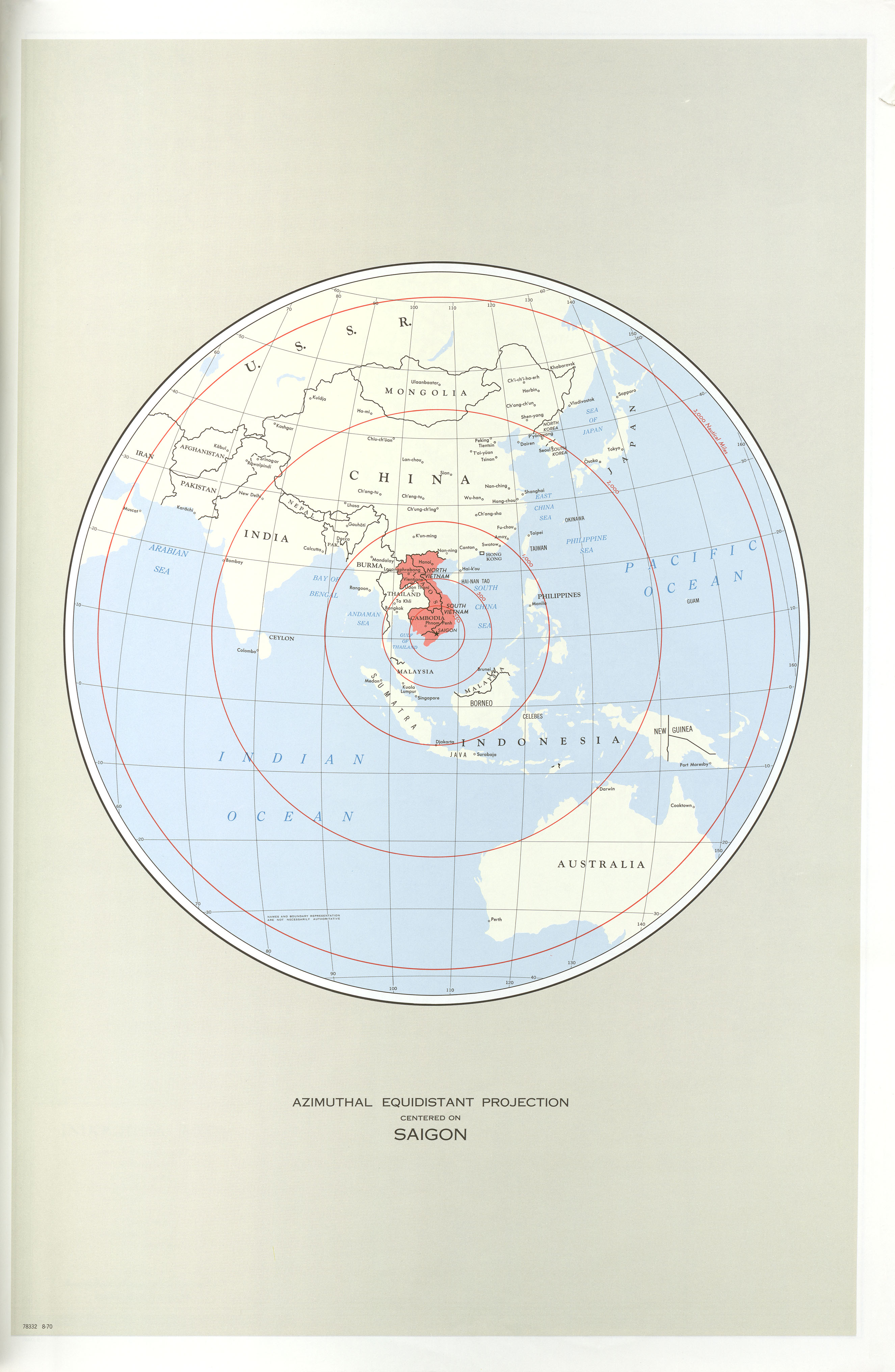
-- Map detail from "Azimuthal Equidistant Projection Centered on Saigon" (CIA, 1965): @

Resources
* Transcript (from "Public Papers of the Presidents of the United States"): @
* Video & audio (Miller Center, University of Virginia): @
* "Build-Up in Viet Nam" (Toledo Blade, July 25, 1965): @
* "President Doubles Draft Call" (United Press International, July 28, 1965): @
* "LBJ Hikes Draft for Viet Nam War" (Associated Press, July 29): @
* "Johnson Tells Why Vietnam in Pamphlet" (Associated Press, August 24): @
* "Why Viet-Nam" (Department of Defense, 1965; includes remarks from Johnson's news conference; from Internet Archive): @
* "Johnson's Escalation of Vietnam: A Timeline" (Bill Moyers Journal, 2009): @ 
* Excerpt from "Presidents and Protestors: Political Rhetoric in the 1960s" (Theodore Windt, 1990): @
* "McNamara, Clifford, and the Burdens of Vietnam" (Secretaries of Defense Historical Series, 2011): @
* Pentagon Papers (National Archives, 1969): @ 

4.17.2015

Saturday, April 17, 1965: March on Washington to End the War in Vietnam


Thousands of students demanding an end to the war in Viet Nam massed in Washington Saturday, picketing, singing and shouting for their case. The demonstration, one of the largest ever to take place around the White House, was billed by its sponsors, an organization calling itself Students for a Democratic Society, as the start of a national protest movement against U.S. policy in Viet Nam. Demonstration leaders said 20,000 students responded to the call they sent to colleges across the nation for support. Police estimated the number at 12,000 to 15,000.
-- Excerpt from Associated Press: @
-- Image of flier from  Students for a Democratic Society Papers, 1958-1970: @

* Summary from "Encyclopedia of Student and Youth Movements" via Facts on File: @
* Flier (The King Center): @
* Paul Potter's speech (www.sdsrebels.com): @
* "Paul Potter, 'The Incredible War' (17 April 1965)": @ (Jeffery P. Drury, Central Michigan University)
* www.sds-1960s.org: @ 

4.07.2015

Wednesday, April 7, 1965: 'Peace Without Conquest' speech

On the evening of April 7, 1965, Lyndon Johnson spoke before a television audience at Johns Hopkins University to offer his rationale for recently ramped up American military presence in Vietnam and to tell the world of U.S. intentions to come to the aid of the people of Southeast Asia in a bold new way. ... The president suggested the whole area be developed and modernized as an alternative to continued war. The speech was designed to encourage those in Hanoi to agree to stop warring and to take part in the development of the region, and also to put a good face on the new American measures implemented since February, including sustained aerial bombardment and combat troops.
     -- From "Inventing Vietnam: The United States and State Building, 1954-1968" (James M. Carter, 2008): @ 

* Video (LBJ Library): @
* Transcript (LBJ Library): @
* "Independent South Viet Must Follow Any Peace Discussion, Says Johnson" (United Press International): @
* National Security Action Memorandum No. 328 (April 6): @ (U.S. State Department) and @ (LBJ Library) 

3.03.2015

March 1965: Vietnam

Tuesday, March 2: Rolling Thunder
     Operation Rolling Thunder was a 44-month-long aerial bombardment campaign carried out against North Vietnam by the U.S. Air Force and Navy and the South Vietnamese air force. The operation was initiated by President Johnson on 2 March 1965 as a continuation of Operation Flaming Dart. The principal aims, the relative significance of which shifted over time, were to improve the morale of the South Vietnamese, persuade North Vietnam to end its aid to the Viet Cong, destroy North Vietnam's industry and transportation, and cut off the flow of men and supplies from North to South.
     -- From "Historical Dictionary of U.S. Diplomacy during the Cold War" (Martin Folly, 2014): @

* The Air War in North Vietnam: Rolling Thunder Begins, February-June 1965" (The Pentagon Papers, Gravel Edition, 1971): @
* "The Air War Against North Vietnam" (U.S. Air Force, 1984): @
* "Rolling Thunder 1965: Anatomy of a Failure" (Col Dennis M. Drew, Air University, 1986): @
* "An Uncommon War: The U.S. Air Force in Southeast Asia" (Bernard C. Nalty, Air Force Historical Studies Office, 2015): @


Monday, March 8: Combat troops
     DA NANG, South Viet Nam, Monday -- Two combat-trained battalions of U.S. Marines began moving ashore today to defend vital U.S. jet air bases at this strategic seaport 80 miles from Communist North Viet Nam. The force of 3,500 Marines began debarking from ships lying off the coast under strict security measures to discourage any Viet Cong interference. They came ashore through pounding surf 10 miles north of Da Nang. ... The landing operation began at 9 a.m. (8 p.m. EST) after a delay of about an hour because of rough seas offshore. The air was hot and humid. ... The Marines are the first American ground troops to be ordered into potential direct combat positions against Viet Cong guerrillas and troops infiltrating from North Viet Nam.
     -- From United Press International: @
     -- Photo from "U.S. Marines in Vietnam: The Landing and the Buildup" (History and Museums Division, U.S. Marine Corps, 1978): @

* "Marines Land in Vietnam" (The Age; Melbourne, Australia): @
* "American Troops Enter the Ground War, March-July 1965" (The Pentagon Papers, Gravel Edition, 1971): @
* "The Third Division in Vietnam" (Third Marine Division Association): @
* "50 Years Ago: Boots on the Ground in Vietnam" (The Saturday Evening Post, 2015): @

2.27.2015

Saturday, February 27, 1965: Vietnam 'white paper'

The United States published a new "white paper" on Viet Nam today that charged North Viet Nam with waging an aggressive war against South Viet Nam as if it were an open invasion. ... An evident purpose of the report, too, is to lend support to the Johnson administration's policy of striking against targets in North Viet Nam. These bombings, undertaken three weeks ago, are expected to continue. ... The white paper was designed to show with precise figures the extent to which Viet Cong guerrillas in the south are supported and controlled by North Viet Nam. Thereby it sought to refute any suggestion that it is simply a civil war being fought in South Viet Nam.
     -- Associated Press (link to story: @)

* "Aggression From the North: The Record of North Viet-Nam's Campaign to Conquer South-Vietnam" (complete report; from The Vietnam Center and Archive, Texas Tech University): @ 

2.18.2015

Thursday, February 18, 1965: 'Grave but by no means hopeless'

Presenting the military budget to Congress, Secretary of Defense Robert McNamara states: "The present situation in South Viet Nam is grave but by no means hopeless." His words echo exactly those of Secretary of State John Foster Dulles in describing the situation in Indochina in 1954.

Dulles, June 4, 1954 (Associated Press story: @) 


* "The Threat of Direct Communist Chinese Intervention in Indochina" (Dulles, June 1954; from The Avalon Project, Yale Law School): @ 
* "The French Indochina War 1946-54" (Martin Windrow, 1998): @ 

McNamara, February 18, 1965 (Associated Press story: @)


* Full text of statement (from Department of Defense): @
* "Extracts of Statements by Robert S. McNamara on the Outlook in South Vietnam" (from The Harold Weisberg Archive): @
* "Leaders' Statements on Southeast Asia Examined" (Associated Press, February 21): @
* Excerpt from "Johnson's War/Johnson's Great Society: The Guns and Butter Trap" (Jeffrey W. Helsing, 2000): @ 

12.15.2014

December 1964: Bob Hope in Vietnam


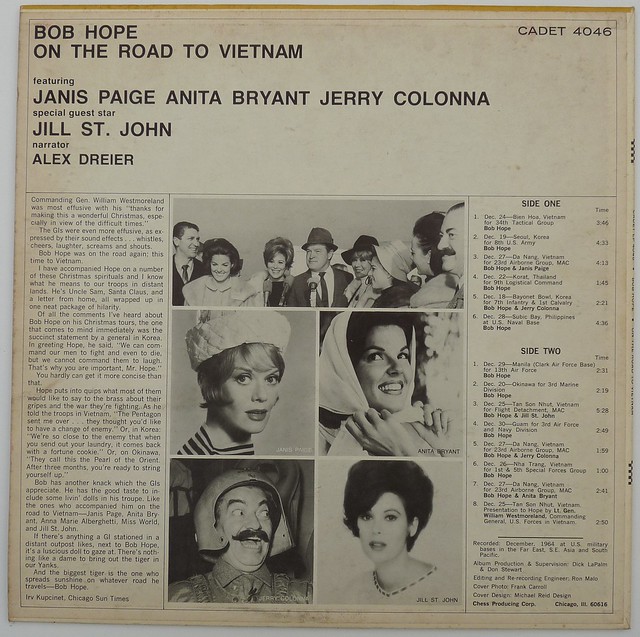
The comedian, who had entertained U.S. troops during World War II and the Korean War, makes his first USO tour of military bases in Vietnam. Segments from the trip were shown on NBC the following January during "The Bob Hope Christmas Special." Hope would continue the holiday tours until 1972.
     -- Stars and Stripes photo from Tan Son Nuht Airport

* "Bob Hope brings Christmas cheer to troops in Vietnam" (Stars and Stripes, December 26, 1964): @
* "The Bob Hope Show; Christmas Day - 1964; Vinh Long, Vietnam" (vinhlongoutlaws.com): @
* "Hope Indomitable" (Associated Press, December 25): @
* Video from Da Nang Air Base (no sound): @
* Video from Camp Enari (no sound): @
* Front and back covers from "On The Road To Vietnam" (1965): @ and @
* Audio from Bien Hoa: @
* "Bob Hope's Vietnam Christmas Tours" (www.history.net): @
* "On the Road: USO Shows -- Bob Hope and American Variety" (Library of Congress): @
* "Entertaining Troops" (www.bobhope.com): @
* Excerpt from "Bob Hope: A Life in Comedy" (William Robert Faith, 1982): @

11.27.2014

Friday, November 27, 1964: Operation Moneybags

     British soldiers are given LSD as part of research into how the drug might affect their capabilities as well as military operations. From the Imperial War Museum's description of the filmed summary (link: @):
     Introductory title places trial in context of recent research to discover chemical agents able to incapacitate enemy forces but with negligible risk of fatal casualties. ... One Marine in state of distress is comforted by nurse, while others smile and laugh hysterically, one attempting to cut down a tree with his spade, and another climbing the tree. ... After exercise Marines rest in bed in Porton ward ... One very distressed Marine is held by duffel coated doctor and scientist, muttering "I am not going to die."  Cut back to end of the exercise, with Marines departing by truck, before concluding title states that despite promising results of experiment, further research is needed into methods of disseminating drug, the effects of larger doses and establishing economical production techniques. "Despite these and other problems, LSD is regarded in the light of present knowledge as one of the drugs which merits more detailed examination and testing."

* Short clip from film: @
* Excerpt from "Albion Dreaming: A Popular History of LSD in Britain" (Andy Roberts, 2012): @
* House of Commons communications (1995): @
* "Drugged and Duped" (Rob Evans, The Guardian newspaper, March 14, 2002): @
* "Weapons Against the Mind" (Dr. W.M. Hollyhock, New Scientist magazine, April 22, 1965): @ 

8.05.2014

Wednesday, August 5, 1964: Everett Alvarez Jr.


Navy Lt. (j.g.) Everett Alvarez Jr. is captured after he ejects from his plane, which was hit during a raid on a North Vietnamese base. He is the first U.S. pilot to be shot down over North Vietnam and held as a POW; he would be released on February 12, 1973.

Photo from Corbis Images. Caption: "In this photo from a Japanese documentary film taken by a Japanese cameraman who was on the scene accidentally when this incident took place, a man identified as Lt. Everett Alvarez (left) is escorted by a North Vietnamese sailor. Alvarez, a U.S. airman, was shot down the U.S. retaliatory raid on North Vietnamese PT boat installations in August."

* Summary from www.pownetwork.org: @
* Summary from U.S. Department of Defense: @
* "Chained Eagle" (Alvarez and Anthony Pitch, 1989): @
* 1981 interview (wgbh.org): @
* 2013 interview (www.historynet.com): @
* "U.S. Retaliation: Air Strike is 'Devastating' " (Associated Press, August 5, 1964): @
* "U.S. Pilot Is Marched By Captors" (Associated Press, August 11, 1964): @
* "First Prisoner Release Completed" (New York Times, February 1973): @
* Earlier post on POW Floyd James Thompson (March 26, 1964): @
* "Two Men, Two Fates" (Stars and Stripes): @

8.02.2014

August 1964: Gulf of Tonkin


Note: The story of what exactly happened in early August off the coast of North Vietnam -- in particular, the events of August 4 -- has been revisited and rewritten several times through the years, as various accounts and documents have come to light. What follows are newspaper excerpts from those days, since that reflects the general public's understanding of the situation at the time. For a review of the military actions as we now understand them, a good place to start is with "The Truth About Tonkin." (Naval History Magazine, February 2008; link: @) 

     -- Photo from U.S. Navy (link: @). Caption: "Photograph taken from USS Maddox (DD-731) during her engagement with three North Vietnamese motor torpedo boats in the Gulf of Tonkin, 2 August 1964. The view shows all three of the boats speeding towards the Maddox."

Sunday, August 2
     "Three Communist patrol boats attacked the destroyer USS Maddox in international waters off the coast of North Viet Nam Sunday with torpedoes and gunfire and the American ship, joined by U.S. Navy jets, fired back." -- United Press International: @
     * "President Johnson has ordered U.S. naval forces beefed up in the Tonkin Gulf area, off Viet Nam, and has ordered them to destroy any force that attacks them." -- Associated Press: @

Tuesday, August 4
     "The defense department announced Tuesday night that a second 'deliberate attack' was made on American destroyers patrolling off North Vietnam." -- Associated Press: @
     "President Johnson announced Tuesday night that 'air action is now in execution against gunboats' of North Vietnam which attacked U.S. destroyers twice in the Gulf of Tonkin." -- Associated Press: @
     * Video and transcript of August 4 speech (Miller Center): @
     * President's Message to Congress (August 5): @
     * "LBJ's Fateful Day: Aug. 4, 1964" (New York Times, 2008): @

Friday, August 7
      "The House of Representatives and the Senate approved today the resolution requested by President Johnson to strengthen his hand in dealing with Communist aggression in Southeast Asia." -- New York Times: @

August 10
     "President Johnson signed the congressional resolution supporting his actions in Southeast Asia and said he hopes it is read around the world as it states plainly 'where America stands.' " -- Associated Press: @
     * Joint Resolution: @
     * Resolution and roll call tally: @

Other resources
* Summary from "The Encyclopedia of the Vietnam War" (2011): @
* Summary from U.S. Department of State: @
* Summary from Naval History and Heritage Command: @
* "USS Maddox (DD-73), 1944-1972: Actions in the Gulf of Tonkin, August 1964" (NHHC): @
* Selected documents (from NHHC): @
* Chronology of events (U.S. Air Force, October 1964): @
* "Presidential Decisions: The Gulf of Tonkin Attacks of August 1964" (Vietnam Information Group, 1968): @
* USS Maddox deck log, August 2: @
* "The Gulf of Tonkin Incident, 40 Years Later" (National Security Archive, 2004): @
* "Skunks, Bogies, Silent Hounds, and the Flying Fish: The Gulf of Tonkin Mystery, 2-4 August 1964" (Robert J. Hanyok, Cryptologic Quarterly, 2001): @
* Excerpt from "Vietnam and America: A Documented History" (1995): @
* "Choosing War: The Lost Chance for Peace and the Escalation of War in Vietnam" (Fredrick Logevall, 1999): @ 

Blog archive

Twitter

Follow: @