Showing posts with label cuba. Show all posts

12.01.2015

Wednesday, December 1, 1965: Freedom Flights


A new chapter in the long, often dangerous and always dramatic exodus of Cubans from their Communist homeland opens today with the start of a refugee airlift. The first plane, a Pan American World Airways DC7C, will leave Miami's International Airport at 7 a.m., carrying only its crew and two officials of the U.S. Public Health and Immigration departments. It will return three hours and 35 minutes later from Varadero, Cuba, with 90 refugees, the first of up to 100,000 expected in the new wave of immigration.
     -- Associated Press, December 1, 1965: @
     -- "First Cubans Begin Flights to US Haven" (AP, December 1): @
     -- "First Refugee Plane Lands" (AP, December 1): @

The last of more than 260,500 Freedom Flight refugees from Fidel Castro's Cuba limped off a plane here yesterday.
     -- Associated Press, April 6, 1973: @

-- 1965 photo from Public Health Image Library, U.S. Centers for Disease Control and Prevention

Resources
* "The Cuban Experience in Florida: Revolution and Exodus" (State Library & Archives of Florida): @
* Freedom Flight Memories and database (The Miami Herald): @
* "In Search of Freedom: Cuban Exiles and the U.S. Cuban Refugee Program" (University of Miami Libraries): @ 
* "Cuban Migration to the United States: Policy and Trends" (Ruth Ellen Wasem, Congressional Research Service, 2009): @
* "An Historic Overview of Latino Immigration and the Demographic Transformation of the United States" (David G. Gutierrez, National Park Service): @
* "Freedom Tower, Miami, Florida" (National Park Service): @
* "The 'Other' Boatlift: Camarioca, Cuba, 1965" (U.S. Coast Guard): @
* "The Cuban Refugee Program" (William L. Mitchell, Social Security commissioner, March 1962): @
* "Cuban Refugees in the United States" (John F. Thomas, The International Migration Review, 1967): @
* "Analysis of Federal Expenditures to Aid Cuban Refugees" (U.S. Department of Health, Education and Welfare, 1971): @ 
* "Cubans in the United States" (Pew Research Center, 2006): @
* Photos (The Miami Herald): @
* Photos (University of Miami Libraries): @
* Cuban Research Institute (Florida International University): @

Books
* "Desperate Crossings: Seeking Refuge in America" (Norman L. Zucker and Naomi Flink Zucker, 1996): @
* "Calculated Kindness: Refugees and America's Half-Open Door, 1945-Present" (Gil Loescher and John A. Scanlan, 1998): @
* "Cubans in America: A Vibrant History of a People in Exile" (Alex Anton and Roger E. Hernandez, 2003): @
* "Encyclopedia of Cuban-United States Relations" (Thomas M. Leonard, 2004): @
* "Americans at the Gate: The United States and Refugees During the Cold War" (Carl J. Bon Tempo, 2008): @
* "International Migration in Cuba: Accumulation, Imperial Designs, and Transnational Social Fields" (Margarita Cervantes-Rodriguez, 2011): @
* "American Immigration: An Encyclopedia of Political, Social, and Cultural Change" (James Ciment and John Radzilowski, editors, 2015): @ 

12.23.2012

Sunday, December 23, 1962: Bay of Pigs prisoners freed


From "Cuba and the United States: A Chronological History" (Jane Franklin, 1996):

In the first stage of an agreement with the United States, Cuba releases 1,113 Bay of Pigs invaders in exchange for $53 million in medicine and baby food. Cuba kept nine of the invaders in prison, releasing the final one in 1986. An additional part of the agreement is that Cuba will allow other Cubans to leave for the United States.

* The Miami News, December 23: @
* The Miami News, December 24: @
* The Miami News, December 25: @
* Pittsburgh Post-Gazette, December 24: @
* From BBC News: @
* From "The Kennedy Years" (Joseph M. Siracusa, 2004): @
* Bay of Pigs chronology (from National Security Archive): @
* Earlier post on Bay of Pigs (April 17-19, 1961): @

11.26.2012

Undated: Hawks and doves

Writing in the December 8, 1962, issue of The Saturday Evening Post, Stewart Alsop and Charles Bartlett recount the meetings and decision-making in Washington during the Cuban Missile Crisis. The article helps popularize the political/military labels "hawks" and "doves" with the following passage:

"The hawks favored an air strike to eliminate the Cuban missile bases, either with or without warning. ... The doves opposed the air strike and favored a blockade."

"Hawk" was a shortened version of "war hawk," which dates to at least 1792.

The article also quotes Secretary of State Dean Rusk as saying, "We're eyeball to eyeball, and I think the other fellow just blinked."

* Saturday Evening Post article (PDF): @
* "War Hawks, Uncle Sam, and The White House: Tracing the Use of Three Phrases in Early American Newspapers" (Donald R. Hickey, Wayne State University, via Readex): @
* "Safire's Political Dictionary" (William Safire, first published in 1968; search for "doves" and "war hawks"): @
* "Of Hawks, Doves -- and Now, Owls" (Graham Allison, Joseph S. Nye and Albert Carnesale, The New York Times, 1985): @  

10.30.2012

October 1962: 'Do You Hear What I Hear?'

Written by Noel Regney and Gloria Shayne at the time of the Cuban Missile Crisis, the song's plea for peace would make it a Christmas standard. It was first recorded by the Harry Simeone Chorale in late 1962, and would become a hit for Bing Crosby in 1963.

* Story from www.americancatholic.org (2007): @
* Noel Regney obituary (2002): @
* Gloria Shayne obituary (2008): @ 

10.28.2012

October 1962: Cuban Missile Crisis

Note: With so many authoritative websites and resources dealing with the crisis (some of which are linked below), what follows is a very abbreviated timeline of the 13 days -- October 16 through October 28 -- that are regarded as the beginning and end of the nuclear showdown between the United States and the Soviet Union.


Tuesday, October 16: President John F. Kennedy is told that a missile site capable of firing nuclear weapons against the United States is under construction in Cuba. The evidence comes from aerial photographs taken October 14. The first meeting of what came to be called ExComm (the Executive Committee of the National Security Council) is held.


Wednesday, October 17: U.S. officials discuss a response, including an airstrike or naval blockade against Cuba.

Thursday, October 18: Kennedy meets with Soviet foreign minister Andrei Gromyko and ambassador Anatoly Dobrynin. Gromyko says the missiles are defensive; Kennedy knows otherwise but does not tell the Soviets.

Friday, October 19: The Joint Chiefs of Staff push their case for military action amid more photos of Soviet activity.

Saturday, October 20: The first Soviet missile is declared "combat-ready."

Sunday, October 21: Kennedy approves the quarantine option.

Monday, October 22: In a nationally televised address, Kennedy announces the quarantine against Cuba. Meanwhile, the United States' B-52 nuclear bomber force begins flights around the clock, with more nuclear-armed aircraft sent to U.S. bases.
* Video (from C-SPAN): @
* Audio, transcript (from JFK Library): @

Tuesday, October 23: The Organization of American States announces its support of the U.S. actions. Cuba's armed forces are placed on their highest alert. Kennedy signs authorization of the naval quarantine.

Wednesday, October 24: The quarantine goes into effect; Soviet ships hold their position or turn back. The Strategic Air Command announces the U.S. armed forces are on DEFCON 2 alert, one level below war.

Thursday, October 25: The countries face off at the United Nations, with the U.S. demanding the USSR confirm or deny the existence of the bases, then presenting photographic evidence of the sites.

Friday, October 26: Soviet premier Nikita Khrushchev sends a letter to Kennedy saying he will order the removal of the missiles if Kennedy pledges not to invade Cuba.

Saturday, October 27: A U-2 aircraft is shot down while flying over Cuba. A second U.S. surveillance aircraft flying from Alaska accidentally strays into Soviet airspace. Kennedy replies to Khrushchev's letter, agreeing to its conditions.

Sunday, October 28: The crisis ends as Khrushchev announces the withdrawal of missiles under U.N. observation. (The U.S. also agrees to remove its missiles from Turkey, though that would not be revealed until years later.)

Websites:
* John F. Kennedy Presidential Library and Museum: @
* Belfer Center for Science and International Affairs, Harvard Kennedy School: @
* National Security Archive: @
* Foreign Policy magazine: @
* www.nuclearfiles.org: @
* The Wilson Center: @


Summaries:
* www.history.com: @
* www.globalsecurity.org: @

Photos:
* From National Security Archive: @


"Foreign Relations of the United States" (from U.S. Department of State)
* Volume X, Cuba, January 1961 - September 1962: @
* Microfiche Supplement: @
* Volume XI, Cuban Missile Crisis and Aftermath, 1961 - 1963: @

Media reports:
* From The New York Times: @
* October 25 newsreel: @
* Life magazine (November 2): @
* Life magazine (November 9): @


Books: 
* "The Cuban Missile Crisis Revisited" (edited by James A. Nathan, 1992): @
* "Cuban Missile Crisis: The Essential Reference Guide" (edited by Priscilla Roberts, 2012): @
* "Thirteen Days" (Robert F. Kennedy, 1968): @
* "Cuba and the United States: A Chronological History" (Jane Franklin, 1997): @
* "President Kennedy: Profile of Power" (Richard Reeves, 1993): @


Other resources:
* Documents (from Avalon Project, Yale Law School): @
* Documents (from Mount Holyoke College): @
* CIA documents (from www.allworldwars.com): @
* Digital Archive, Cold War International History Project: @
* "Clouds Over Cuba" (documentary from JFK Library): @
* "The Armageddon Letters" (multimedia presentation): @
* "Learning from the Missile Crisis" (Smithsonian magazine, October 2002): @ 


3.13.2012

Tuesday, March 13, 1962: Operation Northwoods

A plan drawn up by the U.S. Joint Chiefs of Staff under which the U.S. military would undertake a campaign of terrorism -- including, in some cases, acts of violence against Americans -- as a pretext for blaming and then invading Cuba. The proposal, presented to Secretary of Defense Robert McNamara, was never implemented.

Among the actions outlined in the plan:

"We could blow up a ship in U.S. ship in Guantanamo Bay and blame Cuba."

"We could develop a Communist Cuban terror campaign in the Miami area, in other Florida cities and even in Washington. The terror campaign could be pointed at Cuban refugees seeking haven in the United States. We could sink a boatlad of Cubans en route to Florida (real or simulated). We could foster attempts on lives of Cuban refugees in the United States even to the extent of wounding in instances to be widely publicized. Exploding a few plastic bombs in carefully chosen spots, the arrest of Cuban agents and the release of prepared documents substantiating Cuban involvement also would be helpful in projecting the idea of an irresponsible government."

"It is possible to create an incident which will demonstrate convincingly that a Cuban aircraft has attacked and shot down a chartered civil airliner en route from the United States to Jamaica, Guatemala, Panama or Venezuela."

"It is possible to create an incident which will make it appear than Communist Cuban MIGs have destroyed a USAF aircraft over international waters in an unprovoked attack."

* Original Northwoods documents (from National Security Archive): @
* "Operation Northwoods and the Covert War Against Cuba, 1961-63" (2002, from the journal Cuban Studies): @
* "Body of Secrets: Anatomy of the Ultra-Secret National Security Agency" (book by James Bamford): @
* Memorandum from Joint Chiefs to Secretary of Defense re: Cuba (April 10, 1962): @
* "Probable Reactions to a U.S. Military Intervention in Cuba" (CIA document, April 10; from the Mary Ferrell Foundation): @

2.07.2012

February 1962: Cuba trade embargo

The United States enacts a trade embargo against Cuba "in light of the subversive offensive of Sino-Soviet Communism with which the Government of Cuba is publicly aligned." The White House statement says that "on humanitarian grounds exports of certain foodstuffs, medicines and medical supplies ... would be excepted from this embargo." The order, signed by President Kennedy on February 3, goes into effect on February 7.

* Full text of order: @
* White House statement: @
* Earlier post on partial embargo (October 19, 1960): @

6.04.2011

Saturday-Sunday, June 3-4, 1961: Kennedy and Khrushchev

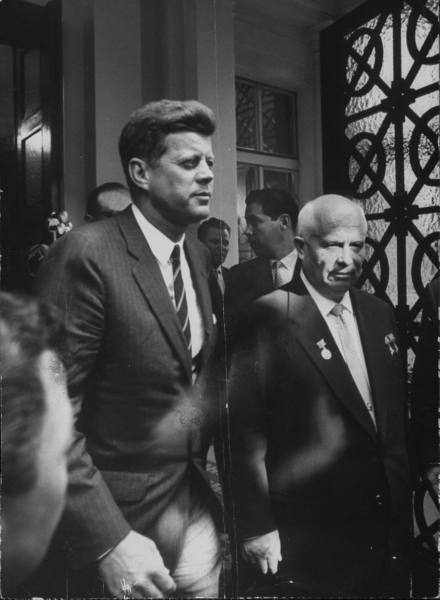
U.S. President Kennedy and Soviet leader Khrushchev meet for two days of informal talks in Vienna, Austria. The talks do not go well, particularly from the American point of view: "He just beat the hell out of me," Kennedy would later say. On a range of issues -- Laos, nuclear testing and particularly Berlin -- Khrushchev was the aggressor, trying to take advantage of what he saw as American weakness in the wake of the failed Bay of Pigs operation in Cuba.

* The Summit Conference at Vienna (from "Foreign Relations of the United States, 1961-1963"): @
* Memo of June 3 talks (from JFK library): @
* Newsreel (from C-SPAN): @
* Transcript of Kennedy's televised speech, June 6: @
* Excerpt from "The Cold War: The essential readings": @
* Excerpt from "Khrushchev: The Man and His Era": @
* Excerpt from "Kennedy's Kitchen Cabinet and the Pursuit of Peace": @
* "Berlin 1961": @

5.01.2011

Monday, May 1, 1961: Hijacked to Cuba

The first hijacking of a U.S. flight occurs when Antulio Ramirez Ortiz, armed with a gun and a knife, takes control of a National Airlines flight en route from Miami to Key West, Florida, and redirects it to Cuba. Ortiz, an electrician in Miami, said he had been offered $100,000 to assassinate Cuban leader Fidel Castro and wanted to reach Cuba to warn Castro. Ortiz was allowed to stay, while the plane, crew and passengers would return to the United States.

* Summary from "The Encyclopedia of Kidnappings" (book by Michael Newton): @
* Account from "Terrorism on American Soil" (book by Joseph T. McCann): @
* Account from flight attendant: @
* History of the Federal Air Marshal Service (from propublica.org): @

4.20.2011

April: Bay of Pigs aftermath

April 20
* Attorney General Robert F. Kennedy's statement on Cuba and neutrality laws: @
* U.S. President John F. Kennedy's address to the American Society of Newspaper Editors: @
* Footage of speech: @

April 21
* Footage of JFK press conference, Part 1: @
* Part 2: @
* Part 3: @ (This contains the Kennedy quote, "There's an old saying that victory has a hundred fathers and defeat is an orphan.")

April 22
* Letter from Soviet leader Nikita Khrushchev to JFK: @
* JFK meets with former President Eisenhower at Camp David, Maryland (photo above). The picture would win the 1962 Pulitzer Prize in photography. The story behind the photo: @

April 24
* The White House releases a statement that reads: "President Kennedy has stated from the beginning that as President he bears sole responsibility for the events of the past few days. He has stated it on all occasions and he restates it now so that it will be understood by all. The President is strongly opposed to anyone within or without the administration attempting to shift the responsibility."

April 27
* JFK address to the American Newspaper Publishers Association: @ (also known as "The President and the Press" speech)

4.17.2011

Monday-Wednesday, April 17-19, 1961: Bay of Pigs

A U.S.-sponsored attempt to topple the government of Cuban leader Fidel Castro fails. An invasion force of some 1,400 Cuban exiles -- trained and financed by the CIA -- goes ashore at the Bay of Pigs. They are routed by government forces. The U.S. had hoped that the operation would spark an uprising against Castro (at lower right in photo); that, too, never takes hold.

* Summary (from americanheritage.com): @
* Summary (from Miami Herald): @
* Summary (from Kennedy library): @
* Summary (from the book "Disasters, Accidents, and Crises in American History"): @

* Letter from Khrushchev to Kennedy (April 18): @
* Letter from Kennedy to Khrushchev (April 18): @

* "Invasion at Bay of Pigs" (from historyofcuba.com): @
* "Assault Brigade 2506 and the Bay of Pigs" (from military.com): @
* "Inspector General's Survey of the Cuban Operation" (from CIA, October 1961): @
* "Official History of the Bay of Pigs Operation" (from CIA): @
* Government documents, April 17-19; start at "106 through 120": @
(from "Foreign Relations of the United States, 1961-1963 -- Volume X, Cuba, 1961-1962")
* Other links to relevant documents: @
* More from National Security Archive: @
* More from cuban-exile.com: @
* "Cuba and the United States: A Chronological History": @

* "Rebels Invade Castro's Cuba:" (newsreel, from britishpathe.com): @
* "Aftermath of the Cuban Episode" (newsreel, from britishpathe.com): @
* Battle footage (from criticalpast.com): @
* Photos (from life.com): @
* New York Times (April 18): Front page @ and article @
* Front page of San Francisco Chronicle (April 20): @

3.11.2011

Saturday, March 11, 1961: U.S. plans for invasion of Cuba

President Kennedy meets with leading civilian and military officials to discuss a U.S.-led plan to topple the government of Cuba's Fidel Castro. (The plan had been set in motion by President Eisenhower on March 17, 1960; click here for entry.) While the details of the plan were secret, the overall goal was not: On January 10, The New York Times had published an article with the headline "U.S. Helps Train an Anti-Castro Force at Secret Guatemalan Air-Ground Base; Clash With Cuba Feared." During the March 11 meeting, Kennedy requested changes in the plan; at a second meeting on March 15, it was agreed that the invasion would take place at The Bay of Pigs.

* Details of meetings (from the book "John F. Kennedy: A Biography"): @
* Details of meetings (from the book "A Thousand Days: John F. Kennedy in the White House"): @
* Details of meetings (from the book "The Bay of Pigs: Cuba 1961"): @
* National Security Action Memorandum No. 31 (from jfklibrary.org): @
* Government documents in days before and after meetings: @ and @
(from "Foreign Relations of the United States, 1961-1963 -- Volume X, Cuba, 1961-1962")


12.26.2010

Monday, December 26, 1960: Operation Pedro Pan begins

Operation Pedro Pan was a program under which children were sent from Cuba to the United States, where they would receive education and care. It was operated by the Catholic Welfare Bureau of Miami and financed in part by the U.S. government. More than 14,000 children made the journey between December 1960 and October 1962, when the Cuban Missile Crisis brought an end to commercial flights between the two countries.

* pedropan.org: @
* Miami Herald site (stories and database): @
* "Operation Pedro Pan: The Untold Exodus of 14,048 Cuban Children" (book): @
* "Escape from Havana: An American Story" (CNBC video): @

11.29.2010

Tuesday, November 29, 1960: Kennedy's Cuba briefing

In November, President-elect John F. Kennedy learns in detail about U.S. plans to help overthrow the government of Cuba. CIA director Allen Dulles meets with Kennedy on November 18 at Kennedy's home in Palm Beach, Florida (photo at left); Dulles tells Kennedy about an invasion force of Cuban exiles being trained in Guatemala.

In the years since, it has been widely reported that a second, more detailed briefing occurred on November 29, during which Kennedy told Dulles to proceed with the operation. However, the CIA says it is very unlikely that this meeting ever took place. Click here for "CIA Briefings of Presidential Candidates"; scroll down to "The Mystery Briefing of Late November."

"A Program for Covert Action Against the Castro Regime" (from March 1960): @

10.19.2010

Wednesday, October 19, 1960: Cuban embargo

The United States imposes a partial economic embargo on Cuba, prohibiting practically all exports to the island nation other than food and medicine. The move comes just days after Cuba had nationalized all U.S. banks. According to the State Department, the aim of the embargo is to "exert a serious pressure on the Cuban economy and contribute to the growing dissatisfaction and unrest in the country." However, a National Intelligence Estimate published in December says that "Economic dislocations will occur but will not lead to the collapse or significant weakening of the Castro regime."

* "Economic Sanctions as an Instrument of U.S. Foreign Policy: The Case of the U.S. Embargo Against Cuba" (book): @
* "Cuba and Economic Sanctions: A Cold War Strategy in the 21st Century" (U.S. Army War College, 2004): @
* Embargo timeline (through 2007): @
* "Cuba: The Battle of America" (CIA film, 1960): @

10.11.2010

September-October, 1960: Khrushchev and the U.N.

* Monday, September 19: Soviet premier Nikita Khrushchev arrives in New York for what will be a contentious session of the United Nations General Assembly. Also in New York is Cuba's leader, Fidel Castro, who had arrived the day before.
-- Footage of Khrushchev and Castro arriving in New York: @

* Tuesday, September 20: The General Assembly opens. Khrushchev and Castro meet for the first time. Afterward, Khrushchev likens Castro to "a young horse that hasn't been broken. He needs some training, but he's very spirited, so we'll have to be careful."
-- Footage of Khrushchev-Castro meeting: @

* Thursday, September 22: U.S. President Eisenhower expresses strong support for the U.N.'s role, particularly its peacekeeping activities in Africa. He also asks: "Will outer space be preserved for peaceful use and developed for the benefit of all mankind? Or will it become another focus for the arms race -- and thus an area of dangerous and sterile competition?"
-- Speech: Summary @ and text @

* Friday, September 23: Speaking for nearly two and a half hours, Khrushchev accuses the West of continuing to seek colonial rule in Africa. He also says the secretary-general's post should be abolished in favor of a three-person committee representing Communist, West and neutralist blocs. After Khrushchev's speech, a New York antiques dealer presents him with an American Indian peace pipe, saying "may the leaders of our two great powers, the USSR and the USA, see in this pipe a new age ... may you and the heads of other states symbolically smoke it together." (Click here for larger view.)
-- Portion of speech: @

* Monday, September 26: Castro speaks for more than four hours. He begins his speech by saying, "Although it has been said of us that we speak at great length, you may rest assured that we shall endeavor to be brief ..."
-- Text of speech: @ and @ (printed version)

* Thursday, September 29: Khrushchev interrupts a speech by British Prime Minister Harold MacMillan, pounding on his desk with his fists and shouting, "You send your planes over our territory, you are guilty of aggression!"
-- BBC summary: @
-- Life magazine coverage: @
-- Footage: @

* Monday, October 3: Khrushchev repeats his call for the removal of Secretary-General Dag Hammarskjold, who replies that by doing so he would "throw the organization to the winds."
-- Footage: @

* Sunday, October 9: Khrushchev is interviewed on the "Open End" TV program, hosted by David Susskind. The interview turns contentious, with Khrushchev at one point threatening to walk off the set. The most memorable exchange:

Khrushchev: ... Our land is sacred and sovereign, and it's only the peoples of the Soviet Union themselves that have the right to govern their land, and administer their affairs. ... Why should you try to poke your nose into our garden? Have you not enough things to do in your own country?
Susskind: You're baying at the moon. ... We believe with all our might that there are many subjugated peoples in Eastern Europe. We ask that a plebiscite be held, not in your home country, not in the Soviet Union, but in many of the countries of Eastern Europe, who are now within the Soviet orbit.
Khrushchev: Is such an expression as "baying at the moon" regarded as normal polite conversation in your country? We regard it as rude. After all, I'm old enough to be your father, and young man, it is unworthy to speak to me like this. You look pleasant enough but you do not express yourself quite courteously. I do not permit an attitude like that towards myself. I did not come here to "bark" -- I am the chairman of the Council of Ministers of the world's greatest socialist state. You will therefore please show respect for me. If you do not want to, then do not invite me for an interview. There must be courtesy, but you are accustomed to prod and knock everyone about. Ours is the kind of state which will not allow itself to be ordered about.

-- More about the near-departure: @
-- Time magazine account: @
-- Photo from interview: @

* Wednesday, October 12: Shoe-banging incident. See separate post below.

* Thursday, October 13: After a final, failed attempt to have the U.N. condemn the United States for its U-2 spy flights, Khrushchev boards a plane and departs from New York. "We are leaving in a good mood," he says.

Other resources:
* "Khrushchev in New York" (Text of speeches, appearances): @
* "Memoirs of Nikita Khrushchev": @

Blog archive

Twitter

Follow: @