Showing posts with label october. Show all posts

10.05.2016

Friday, October 7, 1966: Study of UFOs


The Air Force announced today the University of Colorado has been chosen to undertake independent investigations of reports on unidentified flying objects. Air Force Secretary Harold Brown said the university is being awarded a research agreement of about $300,000 "to analyze phenomena associated with UFO sightings."
     The university, located at Boulder, Colo., will also make recommendations on the Air Force's methods of investigation and evaluating flying saucer reports, a program now known as Project Blue Book, dating back to 1948.
     * "University of Colorado Will Investigate UFOs" (Associated Press): @
     * Image from www.ufoevidence.org (Michigan sightings, 1966): @

* April 5, 1966, hearing by Armed Services Committee, U.S. House of Representatives: @
* "Facts About Unidentified Flying Objects" (Science Policy Research Division, Library of Congress, May 5, 1966): @
* "Unidentified Flying Objects Research Guide" (Naval History and Heritage Command): @
* "The CIA's role in the Study of UFOs, 1947-1990" (CIA): @
* "Congressional Hearings on UFOs" (www.ufoevidence.org): @
* "Ford Press Releases -- UFO, 1966" (Gerald R. Ford Presidential Library & Museum): @
* Journal of UFO History (November-December 2004): @
* "The 1966 UFO Chronology" (National Investigations Committee on Aerial Phenomena): @
* "Ann Arbor vs. the flying saucers" (Michigan Today, 2014): @
* "The Great Michigan UFO Chase of 1966" (www.ufocasebook.com): @
* "Unidentified Flying Objects -- Project Blue Book" (National Archives): @
* Project Blue Book Archive: @ 

11.14.2015

Sunday, November 14, 1965: Battle of Ia Drang Valley


The Battle of Ia Drang Valley was the first major battle between regular U.S. and People's Army of Vietnam (PAVN) troops. The two-part battle occurred at landing zones X-Ray and Albany in Ia Drang Valley, Central Highlands of South Vietnam. Despite heavy casualties on both sides, both claimed the battle was a victory. The battle was considered essential as it set the blueprint for tactics for both sides. American troops continued to reply on air mobility and artillery fire, while the Viet Cong learned that by quickly engaging their combat forces close to the enemy, they could neutralize American advantages.
     -- Summary from thevietnamwar.info
     -- Photo by Peter Arnett for The Associated Press. Caption: U.S. cavalrymen carry a fellow soldier to an evacuation zone after he was seriously wounded in a North Vietnamese ambush in South Vietnam's Ia Drang Valley, mid-November 1965. A battalion of the U.S. 1st Air Cavalry Division was ambushed while marching from the jungle clearing where the Ia Drang Valley fighting started Nov. 14, 1965. 

Postscript: November 30
* Memorandum from Secretary of Defense McNamara to President Johnson: @
* "The Battle of Ia Drang Valley" is broadcast on CBS. Summary: @. Video: @

Resources
* "Heavy Fighting Near Cambodia" (Peter Arnett, AP, November 15, 1965): @
* Summary from "Atlas of American Military History" (2003): @
* Summary from "The Vietnam War" (Andrew Weist, 2009): @
* Summary from "Encyclopedia of the Vietnam War" (2011): @
* Summary from www.history.com: @
* "After Action Report, Ia Drang Valley Operation, 1st Battalion, 7th Cavalry, 14-16 November 1965" (Donovan Research Library, Fort Benning, Georgia): @
* "The Battle at LZ Albany" (Infantry Online, U.S. Army): @
* "Rescue at LZ Albany" (www.historynet.com, 2006): @
* "Fight at Ia Drang" (U.S. Army Center of Military History): @
* "Ia Drang -- The Battle That Convinced Ho Chi Minh He Could Win" (Joseph Galloway, www.historynet.com, 2010): @
* "Death in the Ia Drang Valley" (Jack P. Smith, Saturday Evening Post, January 28, 1967): @ 
* "Battle at Ia Drang" (video, National Geographic): @
* "Vietnam at 50: 1965" (Stars and Stripes): @
* www.lzxray.com (companion site to the 1992 book "We Were Soldiers Once ... and Young"): @
* Other resources (Lehigh University Digital Library): @ 

10.28.2015

Thursday, October 28, 1965: Nostra Aetate


Pope Paul and the Vatican ecumenical council Thursday decreed massive changes for the entire structure of Roman Catholicism. They proclaimed a new and unbiased friendship for Jews and other non-Christians. ... The new decrees oblige Catholics to do unprejudiced thinking and dealing with Jews and others outside Christianity after 2,000 years of turbulent history. ... The documents: Insist that the entire Jewish people cannot be charged with Christ's Crucifixion or depicted as accursed by God; pay respect to Islam and other non-Christian religions and reject any kind of discrimination.
     -- Associated Press: @

* "Declaration on the Relation of the Church to Non-Christian Religions: Nostra Aetate" (Pope Paul VI,  1965): @
* Summary from Berkley Center for Religion, Peace & World Affairs: @
* "Nostra Aetate: What Is It?" (Anti-Defamation League): @
* "Guidelines and Suggestions for Implementing the Conciliar Declaration 'Nostra Aetate' " Commission for Religious Relations with the Jews, 1974): @
* "Notes on the correct way to present the Jews and Judaism in preaching and catechesis in the Roman Catholic Church" (Commission for Religious Relations with the Jews): @
* " 'Nostra Aetate,' Forty Years After Vatican II; Present & Future Perspectives" (Commission for Religious Relations with the Jews, 2005): @
* Related resources (Council of Centers on Jewish-Christian Relations): @
* Related resources (JesuitResource.org, Xavier University): @
* "No Religion Is An Island: The Nostra Aetate Dialogues" (1998): @
* "Nostra Aetate: Origins, Promulgation, Impact on Jewish-Catholic Relations" (2007): @ 
* "Stepping Stones to Other Religions: A Christian Theology of Inter-religious Dialogue" (Dermot A. Lane, 2011): @
* "Interreligious Friendship After Nostra Aetate" (2015): @

10.15.2015

Friday, October 15, 1965: David Miller burns his draft card


Tuesday, August 31
President Johnson signed into law Tuesday legislation to prohibit the destruction of draft cards. The measure is an outgrowth of student protests against U.S. policy in Viet Nam. The bill, introduced by Rep. L. Mendel Rivers, D-S.C., was rushed through Congress following reports persons had burned or ripped up their draft cards in protest against the Viet Nam War. The new law makes any person found guilty of destroying the wallet-size Selective Service cards subject to a $10,000 fine or a five-year prison term. Alteration and forgery of drafts cards already is a federal offense, punishable by fines of up to $10,000 and jail terms of up to five years.
     -- United Press International; full text of law (Government Printing Office): @

Friday, October 15
At an anti-war rally in New York, David Miller burns his draft card. Miller would be arrested three days later, becoming the first person charged under the new law. (After a lengthy court battle, he would serve 22 months in federal prison starting in June 1968.)
     -- Photo from Corbis Images

* "Memoirs of a Draft-Card Burner" (Miller, 2002): @
* "Draft Card Burner Arrested by F.B.I." (October 18, 1965): @
* "A Serious To-Do About a Silly Law" (Loudon Wainwright, Life magazine, March 4, 1966): @
* "Card Burner Raps Penalty" (Associated Press, March 15, 1966): @
* United States v. Miller (decided October 13, 1966; from Casetext): @
* "Appeal Rejected by High Court" (UPI, February 13, 1967): @
* "Draft Card Burner Nears 'High Noon' " (Washington Post, July 1967): @
* United States v. O'Brien (decided May 27, 1968; from FindLaw): @
* "Reflections of a Draft Card Burner" (Newspaper Enterprise Association, March 1972): @
* "Confronting the War Machine: Draft Resistance During the Vietnam War" (Michael S. Foley, 2003): @
* Entry from "Encyclopedia of American Civil Liberties" (2006): @
* "America's Army: Making the All-Volunteer Force" (Beth L. Bailey, 2009): @ 
* Entry from "Civil Disobedience: An Encyclopedic History of Dissidence in the United States" (2015): @

10.11.2015

Monday, October 11, 1965: Vinland Map


Yale University scholars sliced the frosting off Christopher Columbus' birthday cake Sunday. They've found an ancient map which they say proves that Leif Ericson and other Vikings had explored North America long before Columbus set sail. The map was drawn about 1440 A.D., half a century before Columbus' voyage -- probably by a monk in Basel, Switzerland, using source materials dating back at least to the 13th century, the Yale University Library announced. Greenland is drawn very accurately on the parchment map, and to the west is "Vinland." ... A handwritten notation reads "Discovered by Bjarni and Leif." 
     The map, measuring 11 by 16 inches, will go on display at the Yale library on Tuesday, Columbus Day. Today (October 11) Yale University Press is publishing a book, "The Vinland Map and the Tartar Relation," including reproductions of the map and a manuscript with which it was found.
     -- Associated Press, October 11: @

* "When America Was Called Vinlandia" (Life magazine, October 22, 1965): @
* "Vinland Re-Read" (Paul Saenger, Newberry Library, 1998): @
* "Map Linked to Vikings a Fake, Study Says" (New York Times, February 28, 2000): @
* "Scientists Determine Age of New World Map" (Brookhaven National Laboratory, 2002): @
* "Determination of the Radiocarbon Age of Parchment of the Vinland Map" (Donahue, Olin and Harbottle, Radiocarbon, 2002): @
* "Maps, Myths, and Men: The Story of the Vinland Map" (Kirsten A. Seaver, 2004): @
* "The Viking Deception" ("Nova," PBS, 2005): @ 
* "The Vinland Map -- Some 'Finer Points' of the Debate" (J. Huston McCulloch, Ohio State University, 2005): @
* "Secrets: A Viking Map?" (Smithsonian Channel, 2013): @
* "The Vinland Map" (McCrone Research Institute): @
* "Medieval or Modern?" (Institute for Dynamic Educational Advancement): @ 

10.08.2015

Friday, October 8, 1965: LBJ surgery


President Johnson underwent 2 hours 15 minutes of major surgery Friday for removal of his gall bladder and a kidney stone. Three hours later he was reported "doing well."
     -- Associated Press: @ 

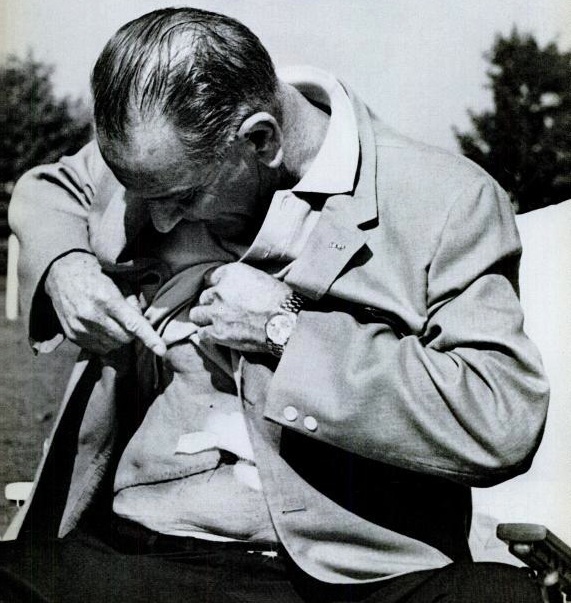
Johnson returned to the White House on October 21. The day before, at Bethesda Naval Hospital, he showed the press his surgical scar. The image would be the basis of a famous cartoon by David Levine, with the scar in the shape of Vietnam (The New York Review of Books, May 12, 1966). Mad magazine would take a similar approach in its January 1968 issue: @

* "Statement by the President That He Would Undergo Surgery" (October 5; American Presidency Project): @ 
* October 8 entry from LBJ Presidential Library: @
* " 'Two Operations for the Price of One' " (Life magazine, October 29): @ 
* David Levine's illustrations for The New York Review of Books: @
* www.davidlevineart.com: @

10.03.2015

October 1965: 'Midlife crisis'


The term is coined by psychologist and social analyst Elliot Jaques in his paper "Death and the Mid-Life Crisis," published in the International Journal of Psychoanalysis.

As summarized in The Psychoanalytic Quarterly (1967):

At age thirty-five the individual has reached the summit of life and sees a declining path before him with death at its end. This results in a crisis, stronger in some than others, connected with having to accept the reality of one's death. It is a period of anguish and depression at the anticipated loss of one's life and revives the infantile experience of loss of the good object (mother). Working through the infantile experience again increases one's confidence in being able to love and mourn what has been lost and increases the possibility of enjoying full maturity and old age. If creativity is present, it may take on new depths and shades of feeling. Dante's descent through Purgatory is essentially an expression of the mid-life crisis and its resolution.

* Complete text as reprinted in "Is It Too Late? Key Papers on Psychoanalysis and Ageing" (2006): @
* Entry from Encyclopedia.com (includes links to various summations): @
* Entry from Psychology Today: @
* "Middle Age Couples Are In Comfortable Rut" (Alison Goddard, Women's Medical News Service, 1970): @
* "Passages: Predictable Crises of Adult Life" (Gail Sheehy, 1976): @; author's website: @
* "Men in Midlife Crisis" (Jim Conway, 1997): @
* "The Existential Necessity of Midlife Change" (Carlo Strenger and Arie Ruttenberg, Harvard Business Review, 2008): @
* "Midlife Crisis: A Myth or a Reality in Search of a New Name?" (Vivian Diller, Psychology Today, 2011): @
* "The Myth of the Midlife Crisis" (Anne Tergeson, Wall Street Journal, 2014): @
* "The Intellectual Odyssey of Elliot Jaques: From Alchemy To Science" (Douglas Kirsner, www.psychoanalysis-and-therapy-com): @
* Obituaries for Jaques, who died in 2003: @ (The New York Times) and @ (The Guardian)
* Midlife Club: @
* The World of Dante (University of Virginia): @
* Danteworlds (University of Texas at Austin): @

10.02.2015

October 1965: Gatorade


    Gatorade was the result of an offhand question posed in 1965 by assistant football coach Dewayne Douglas to Dr. J. Robert Cade, a professor renal medicine: "Why don't football players ever urinate during a game?" Cade and his team of researchers -- Drs. Alejando de Quesada, Jim Free and Dana Shires -- began investigating dehydration on the sports field -- a topic on which no reliable data existed.
     They soon designed and tested a drink that replaced the electrolytes lost through sweat during intense exercise. With the permission of the coaches, Cade's team was allowed to test the drink on the freshman football team, which unexpectedly beat the upperclassmen in a practice session (Friday, October 1). Ray Graves, Florida's head coach, immediately ordered up a large batch for his varsity squad, and on Saturday, October 2, the Gators upset the fifth-ranked LSU Tigers, 14-7.
     -- Summary from Cade Museum for Creativity + Invention, Gainesville, Florida
     -- Photo of Florida offensive coordinator Ed Kensler and quarterback Steve Spurrier, September 1966; in the early days players drank the mixture from milk cartons provided by the university's Department of Dairy Science. Image from University of Florida.


* "Gators Do It Again, 14-7" (Ocala Star-Banner, October 3, 1965): @
* "The Taste That's Gatorade" (Newspaper Enterprise Association, April 18, 1967): @
* "Gatorade Gives the Gators Their GO!" (All Florida magazine, April 23, 1967): @
* "Guzzling Gatorade" (Red Smith, September 7, 1967): @
* "The Bottle and the Babe" (Sports Illustrated, July 1, 1968): @
* Interview with Robert Cade (1996; University of Florida Digital Collections): @
* "Gatorade: The Idea That Launched an Industry" (Office of Research, University of Florida, 2003): @ 
* "First in Thirst: How Gatorade Turned the Science of Sweat Into a Cultural Phenomenon" (Darren Rovell, 2006): @
* University of Florida historical marker (dedicated 2007): @
* "Raise a Glass to the Father of Energy Drinks" (New York Times, 2007): @
* A Little Glucose, A Little Sodium, One Giant Legend" (The Post, Health Science Center, University of Florida, December 2007-January 2008, page 4): @
* "Dr. Cade Wins the Orange Bowl" (chapter from "It Happened in Florida: Remarkable Events That Shaped Florida History," 2009): @ 
* "Waterlogged: The Serious Problem of Overhydration in Endurance Sports" (Tim Noakes, 2012): @
* "Gator Go: The Story of a Failed Sports Drink" (Home: Living in the Heart of Florida magazine, October 2014): @ 
* "Lightning in a Bottle" (SportsBusiness Daily, 2015): @
* "Innovation Turns 50" (Office of Research, University of Florida): @
* "The Sweat Solution" (ESPN Films, 2015): @

9.25.2015

Saturday, September 25, 1965: 'In Cold Blood'


The first installment of Truman Capote's four-part series is published in The New Yorker magazine. It would be published in book form in January 1966.

* First installment (www.newyorker.com): @
* Second through fourth installments (www.newyorker.com; subscription required): @
* Book: @
* "Horror Spawns A Masterpiece" (Life magazine, January 7, 1966): @
* "The Story Behind a Nonfiction Novel" (George Plimpton, The New York Times, January 16, 1966): @
* Review by Stanley Kauffmann, The New Republic (January 22, 1966): @
* "Truman Capote and the Legacy of 'In Cold Blood' " (Ralph F. Voss, 2011): @ 

11.04.2014

Tuesday, November 3, 1964: Pay television

Californians have voted to outlaw pay television and, in the process, dealt a crippling blow to the ambitious firm that hoped to pioneer the medium across the nation.
     Sylvester L. (Pat) Weaver, president of Subscription Television, Inc., now operating in Los Angeles and San Francisco, declined comment until more votes are counted.
     But a spokesman for the firm said the defeat, by a better than 2 to 1 margin, will be appealed in the courts.
     "You can't vote down free enterprise," said the spokesman. "It's patently unconstitutional, clearly a violation of the First Amendment."
     Proposition 15, an initiative backed by a $1.5 million kitty from theater owners, declared pay TV "contrary to public policy."
     A leader of the fight against pay TV was Eugene V. Klein, president of National General Corporation, which operates 217 theaters, mostly in California.
     "It's obvious that the people of California are for free TV to pay TV.  Californians find it obnoxious to pay $1.50 to watch the Los Angeles Dodgers and the San Francisco Giants while the rest of the country gets their baseball on free TV," said Klein.
     The subscription system transmits its program by coaxial cable to a little box which attaches to the customer's regular TV set. There are three channels. Picture, quality and sound are of high caliber.
     The box permits reception of sound and picture and sends back impulses so the firm can know by electronic bookkeeping how much to bill subscribers.
     -- Associated Press, November 4
     -- Image from campaign against pay TV  (videos: @ and @)

* California ballot proposition, 1964 (University of California Hastings Law Library): @
* "The Box: Will it revolutionize TV, reshape the movies, retune the American mind?" (Life magazine, July 17, 1964): @
* "Pay TV: The Day The Money Stopped" (New York Times, November 15): @
* "Stupid Question, Stupid Answer" (Life, November 20): @
* "California High Court Voids Ban on Pay TV" (United Press International, March 3, 1966): @
* "Court Hits California Pay-TV Ban" (Associated Press, October 10, 1966): @
* "Pay Television" (Museum of Broadcast Communications): @
* "Hollywood in the Age of Television" (edited by Tino Balio, 1990): @ 
* "The Rise of Cable Programming in the United States: Evolution or Revolution" (Megan Mullen, 2003): @

10.30.2014

Friday, October 30, 1964: Buffalo wings


Buffalo chicken wings are divided into two pieces (the wingtips discarded), then fried and coated with a mild, oil-based hot sauce; and served with blue cheese dressing and celery sticks. They were invented by Teressa Bellissimo October 30, 1964, at the Anchor Bar in Buffalo, New York ... No food origin story is ever simple, and even this recent and well-recorded event has three versions: 1. The wings were a spontaneous snack for Bellissimo's son Frank and friends; 2. The wings were a Friday-midnight inspiration for Catholic customers who had not had meat all day; 3. The wings had been delivered in error instead of necks and backs for spaghetti sauce or stock, and were salvaged as appetizers.
     -- Image from Anchor Bar menu

* Anchor Bar website: @
* Entry from "Atlas of Popular Culture in the Northeastern United States" (click on "Buffalo Wings"): @
* Entry from "The Story Behind the Dish: Classic American Foods" (Mark McWilliams, 2002): @
* Entry from "Frommer's 500 Places for Food and Wine Lovers" (Holly Hughes, 2009): @
* "An Attempt to Compile a Short History of the Buffalo Chicken Wing" (Calvin Trillin, The New Yorker, August 1980): @ 

10.28.2014

Wednesday-Thursday, October 28-29, 1964: 'T.A.M.I. Show'


Filmed over two days at the Santa Monica (Calif.) Civic Auditorium, "The T.A.M.I. Show" (short for  Teenage Awards Music International or Teen Age Music International) featured some of the biggest stars in rock and pop music, including The Rolling Stones, James Brown and the Flames, The Supremes, The Beach Boys and Lesley Gore. It was released in theaters in December 1964.

* Movie trailer: @
* Summary from New York Times: @
* "14 Things You Didn't Know About Epic Rock Doc The T.A.M.I. Show" (Esquire magazine, 2014): @
* "The Rock Concert That Captured an Era" (Smithsonian magazine, 2010): @
* "The T.A.M.I. Show: A Groundbreaking '60s Concert" (NPR, 2010): @
* "DVD Review: The T.A.M.I. Show" (PopDose, 2010): @
* "The TAMI Show Remembered on Its 40th Anniversary" (Stephen Rosen, Indiewire, 2004): @
* "TAMI, Electronovision's Latest, Gets N.Y. Showing" (Billboard magazine, November 21, 1964): @

10.27.2014

Tuesday, October 27, 1964: 'A Time for Choosing'


On October 27, 1964, future president Ronald Reagan delivered a 30-minute television campaign speech for Republican presidential candidate Barry Goldwater. Later titled the "A Time for Choosing" speech, it raised hundreds of thousands of dollars for the Goldwater campaign and helped launch Reagan's political career.
     -- Summary by C-SPAN
Note: The speech, televised by NBC, had been taped a week earlier and was more a reflection of Reagan's own political views than it was an explicit endorsement of Goldwater. Estimates of how much money it raised vary widely, with some saying it ran into the millions.

* Watch the speech (video from Reagan Foundation): @
* Transcript (American Rhetoric): @
* "Why Ronald Reagan's 'A Time for Choosing' endures after all this time" (Stephen F. Hayward, for The Washingon Post, October 2013): @
* "Ronald Reagan and 'A Time for Choosing' " (Los Angeles Times, February 2011): @
* "The Myth of Reagan's GOP convention speech in 1964" (National Constitution Center): @
* Excerpt from "The Right Moment: Ronald Reagan's First Victory and the Decisive Turning Point in American Politics" (Matthew Dallek, 2000): @

10.22.2014

Thursday, October 22, 1964: 'Choice'


Supporters of Senator Barry Goldwater have produced a television film featuring semi-nude dancing girls, pornographyic magazine covers, street riots and a girl in a topless swim suit to show the "moral decay" of the nation since President Johnson took office. The film called Choice was reported to be the idea of Mothers for Moral America, a group backing the Republican Presidential candidate in the election campaign. ... The film will be shown jointly by the Mothers for Moral American and Citizens for Goldwater-Miller to the press at the national press club today. It is also due to be shown over a national television network today. (Full story: @)
     Note: "Choice" never aired. Goldwater himself repudiated the film once he saw it. 
     
-- Photo of newspaper clipping from CONELRAD (link below)

* Watch the film (video posted by CONELRAD): @
* "Goldwater Rejects Supporters' Film as 'Nothing but Racist' " (The Milwaukee Journal, October 22): @
* " 'Choice' (1964): The Scrapook" (CONELRAD; includes links to related entries): @
* "Barry Goldwater's Mothers for Moral America" (CONELRAD): @
* "The First Days of the Loaded Political Image" (New York Times, September 1996): @
* Excerpt from "Packaging the Presidency: A History and Criticism of Presidential Campaign Advertising" (Kathleen Hall Jamieson, 1996; begins on page 212): @
* Excerpt from "A Glorious Disaster: Barry Goldwater's Presidential Campaign and the Origins of the Conservative Movement" (J. William Middendorf II): @
* Excerpt from "Mothers of Conservatism: Women and the Postwar Right" (Michelle M. Nickerson, 2012): @
* Excerpt from "Barry Goldwater and the Remaking of American Political Landscape" (2013): @ 

Blog archive

Twitter

Follow: @