Showing posts with label LBJ. Show all posts

11.14.2015

Sunday, November 14, 1965: Battle of Ia Drang Valley


The Battle of Ia Drang Valley was the first major battle between regular U.S. and People's Army of Vietnam (PAVN) troops. The two-part battle occurred at landing zones X-Ray and Albany in Ia Drang Valley, Central Highlands of South Vietnam. Despite heavy casualties on both sides, both claimed the battle was a victory. The battle was considered essential as it set the blueprint for tactics for both sides. American troops continued to reply on air mobility and artillery fire, while the Viet Cong learned that by quickly engaging their combat forces close to the enemy, they could neutralize American advantages.
     -- Summary from thevietnamwar.info
     -- Photo by Peter Arnett for The Associated Press. Caption: U.S. cavalrymen carry a fellow soldier to an evacuation zone after he was seriously wounded in a North Vietnamese ambush in South Vietnam's Ia Drang Valley, mid-November 1965. A battalion of the U.S. 1st Air Cavalry Division was ambushed while marching from the jungle clearing where the Ia Drang Valley fighting started Nov. 14, 1965. 

Postscript: November 30
* Memorandum from Secretary of Defense McNamara to President Johnson: @
* "The Battle of Ia Drang Valley" is broadcast on CBS. Summary: @. Video: @

Resources
* "Heavy Fighting Near Cambodia" (Peter Arnett, AP, November 15, 1965): @
* Summary from "Atlas of American Military History" (2003): @
* Summary from "The Vietnam War" (Andrew Weist, 2009): @
* Summary from "Encyclopedia of the Vietnam War" (2011): @
* Summary from www.history.com: @
* "After Action Report, Ia Drang Valley Operation, 1st Battalion, 7th Cavalry, 14-16 November 1965" (Donovan Research Library, Fort Benning, Georgia): @
* "The Battle at LZ Albany" (Infantry Online, U.S. Army): @
* "Rescue at LZ Albany" (www.historynet.com, 2006): @
* "Fight at Ia Drang" (U.S. Army Center of Military History): @
* "Ia Drang -- The Battle That Convinced Ho Chi Minh He Could Win" (Joseph Galloway, www.historynet.com, 2010): @
* "Death in the Ia Drang Valley" (Jack P. Smith, Saturday Evening Post, January 28, 1967): @ 
* "Battle at Ia Drang" (video, National Geographic): @
* "Vietnam at 50: 1965" (Stars and Stripes): @
* www.lzxray.com (companion site to the 1992 book "We Were Soldiers Once ... and Young"): @
* Other resources (Lehigh University Digital Library): @ 

11.09.2015

Tuesday-Wednesday, November 9-10, 1965: Great Northeast Blackout


The nation's worst power failure plunged an estimated 30 million persons into darkness tonight in the huge metropolitan areas of the Northeast and President Johnson ordered an immediate investigation.
     -- Associated Press, November 9: @

Lights flashed on in New York city early Wednesday and transportation systems slowly began to move, signaling the end of a massive and frightening electric power blackout that brought hardship, cold and fear to 30 million persons. But New York city remained crippled because hundreds of thousands of workers could not get to their jobs. The city was still partly paralyzed. Little was normal.
     -- Milwaukee Journal, November 10: @

The enormous scope of the nation's most stunning technological breakdown became starkly clear today, but the cause of the 10-hour blackout remained itself a dark mystery.
     -- Associated Press, November 10: @

     -- Photo by Bob Gomel; published in Life magazine, November 19, 1965: @

* Blackout History Project (George Mason University): @
* NBC television coverage: @
* WABC radio broadcasts, November 9-10: @
* New York Times front page, November 10: @
* "Week of Wonders -- November 14, 1965" (pastdaily.com): @ 
* "Report to the President by the Federal Power Commission on the Power Failure in the Northeastern United States and the Province of Ontario on November 9-10, 1965" (December 6, 1965): @
* "From Here to Maternity" (snopes.com, 2007): @
* "When the Lights Went Out: A History of Blackouts in America" (David E. Nye, 2010): @
* Photos by Rene Burri: @

11.06.2015

Saturday, November 6, 1965: 'Restoring the Quality of Our Environment'


Rachel Carson's "Silent Spring" brought public attention to the pesticide menace contaminating the environment, but this only dealt with one portion of the problems Americans started referring to as "pollution." Evidence of this growing national concern was the appointment of an Environmental Pollution Panel by the President's Science Advisory Committee. In 1965 the panel produced a report that chronicled the concerns that dominated environmental policy and legislation for the reminder of the 20th century. ... The panel explained that air, water and land pollution threatens the "health, longevity, livelihood, recreation, cleanliness and happiness of citizens" who cannot escape their influence. ... Consistent with Carson's explanation of the dangers of DDT, the panel made an ecological argument for the necessity of federal environmental management.
     -- "Social History of the United States" (2009): @

In a comprehensive report titled "Restoring the Quality of Our Environment," the PSAC Environmental Pollution Panel (President's Science Advisory Committee, 1965) considered pollution in its broadest contest and made more than a hundred specific recommendations. The philosophy of the panel was based on the assumption that pollution is a by-product of a technological society and that pollution problems will grow with increases in population and improved living standards unless drastic counter-measures to reduce it are taken. The panel offered some sweeping recommendations that placed problems of pollution in a new perspective.
     -- "Land Use and Wildlife Resources" (National Academy of Sciences, 1970): @

A tax on polluters was suggested today by a Presidential advisory group as one way to fight environmental pollution. Environment pollution is a new term that includes such matters as excessive noise and junkyards as well as dirty water and fouled air. The "polluters' tax" was one of more than 100 recommendations made by 14 physicians, scientists and engineers of the President's Science Advisory Committee. The panel advanced in its report a philosophy of "individual rights to quality of living." "There should be no right to pollute," it said. 
     -- New York Times: @

* Full text of report (Hathi Trust Digital Library): @
* President Johnson statement (American Presidency Project): @
* Climate Central: @
* "Top 5 Climate Change Websites" (Carbon Literacy Project): @
* "The Discovery of Global Warming" (American Institute of Physics): @
* "Advancing the Science of Climate Change" (National Research Council, 2010): @
* "The Oxford Handbook of Climate Change and Society" (2011): @

10.15.2015

Friday, October 15, 1965: David Miller burns his draft card


Tuesday, August 31
President Johnson signed into law Tuesday legislation to prohibit the destruction of draft cards. The measure is an outgrowth of student protests against U.S. policy in Viet Nam. The bill, introduced by Rep. L. Mendel Rivers, D-S.C., was rushed through Congress following reports persons had burned or ripped up their draft cards in protest against the Viet Nam War. The new law makes any person found guilty of destroying the wallet-size Selective Service cards subject to a $10,000 fine or a five-year prison term. Alteration and forgery of drafts cards already is a federal offense, punishable by fines of up to $10,000 and jail terms of up to five years.
     -- United Press International; full text of law (Government Printing Office): @

Friday, October 15
At an anti-war rally in New York, David Miller burns his draft card. Miller would be arrested three days later, becoming the first person charged under the new law. (After a lengthy court battle, he would serve 22 months in federal prison starting in June 1968.)
     -- Photo from Corbis Images

* "Memoirs of a Draft-Card Burner" (Miller, 2002): @
* "Draft Card Burner Arrested by F.B.I." (October 18, 1965): @
* "A Serious To-Do About a Silly Law" (Loudon Wainwright, Life magazine, March 4, 1966): @
* "Card Burner Raps Penalty" (Associated Press, March 15, 1966): @
* United States v. Miller (decided October 13, 1966; from Casetext): @
* "Appeal Rejected by High Court" (UPI, February 13, 1967): @
* "Draft Card Burner Nears 'High Noon' " (Washington Post, July 1967): @
* United States v. O'Brien (decided May 27, 1968; from FindLaw): @
* "Reflections of a Draft Card Burner" (Newspaper Enterprise Association, March 1972): @
* "Confronting the War Machine: Draft Resistance During the Vietnam War" (Michael S. Foley, 2003): @
* Entry from "Encyclopedia of American Civil Liberties" (2006): @
* "America's Army: Making the All-Volunteer Force" (Beth L. Bailey, 2009): @ 
* Entry from "Civil Disobedience: An Encyclopedic History of Dissidence in the United States" (2015): @

8.06.2015

Friday, August 6, 1965: Voting Rights Act


WASHINGTON -- President Johnson signed his monumental Negro voting rights bill today, treading the century-old path of Abraham Lincoln, and declaring the new law is a triumph for freedom as great as any won on the battlefield.
     First, in the vaulted rotunda of the Capitol, Johnson said the measure will "strike away the last major shackles of those fierce and ancient bonds" which have bound American Negroes. ... Then he moved to the ornate President's Room off the Senate chamber, to etch his signature with dozens of souvenir pens, writing on a desk that Secretary Felton Johnson said Lincoln used in signing a measure to free slaves impressed into war service by the Confederacy. ... 
     By next week, he said, federal officials will be at work in the South, registering Negroes who have been kept from the polling place.
     -- Story from Associated Press (full story: @)
     -- Top photo, Johnson signing bill into law (Corbis); bottom photo, Camden, Alabama, 1966 (Flip Schulke)

* First and last page (www.ourdocuments.gov): @
* Full text (U.S. Statutes at Large, Volume 79, 89th Congress, 1st Session): @
* Text of LBJ speech (LBJ Library): @
* Video of LBJ speech (LBJ Library): @
* Universal Newsreel (Critical Past): @
* Photos (LBJ Library; search for "Voting Rights Act"): @ 
* Photos ("50th Anniversary of the Voting Rights Act," Corbis Images): @
* "Voting Rights Legislation Means Changes For South" (James Marlow, Associated Press, August 9, 1965): @ 
* "A Million New Negro Voters?" (U.S. News & World Report, August 16, 1965; from Library of Congress): @
* "LBJ Signs Voting Bill; Attacks Poll Tax" (Jet magazine, August 19, 1965): @
* "The New Voting Law Goes into Action" (Life magazine, August 20, 1965): @
* "Introduction to Federal Voting Rights Law" (U.S. Department of Justice): @
* "Civil Rights in America: Racial Voting Rights" (National Historic Landmarks Program): @
* "Bending Toward Justice: The Voting Rights Act and the Transformation of American Democracy" (Gary May, 2013): @
* "The Most Fundamental Right: Contrasting Perspectives on the Voting Rights Act" (edited by Daniel McCool, 2012): @
* "Quiet Revolution in the South: The Impact of the Voting Rights Act, 1965-1990" (edited by Chandler Davidson and Bernard Grofman, 1994): @ 

8.05.2015

Thursday, August 5, 1965: CBS report on Cam Ne, South Vietnam


CBS airs Morley Safer's report on U.S. Marines setting fire to houses in Cam Ne, a village southwest of Da Nang Air Base in South Vietnam. Reaction ranges from unease to outrage (by viewers angry at CBS, as well as by President Johnson in a blistering phone call to CBS President Frank Stanton). The report is considered a milestone moment in media coverage of the Vietnam War.
     -- The incident at Cam Ne took place on August 3, while Safer's report aired on August 5. The story at top appeared August 3 in the Logansport (Indiana) Pharos-Tribune; the photo ran August 7 in The La Crosse (Wisconsin) Tribune.

* Watch the segment (CBS News): @
* Video interview with Safer (Archive of American Television, 2000): @
* Account from Safer (from "Reporting America at War," PBS, 2003): @
* "Marines Ordered to Stop Burning Viet Nam Villages" (Los Angeles Times, August 23, 1965): @
* "What Really Happened at Cam Ne" (www.historynet.com, 2006): @
* "When The World Began Watching" (The Alicia Patterson Foundation, 2011): @
* "The Power and The Profits: Part II" (David Halberstam, The Atlantic magazine, February 1976): @
* "The Powers That Be" (Halberstam, 1975): @
* Video interview with Halberstam (WGBH, 1979): @
* "The 6:00 Follies: Hegemony, Television News, and the War of Attrition" (Elizabeth J. Burnette, American Studies at the University of Virginia, 2005): @
* Excerpt from "The Uncensored War: The Media and Vietnam" (Daniel C. Hallin, 1986): @
* Excerpt from "The Legacy: The Vietnam War in the American Imagination" (from chapter titled "Vietnam and the Press," Michael X. Delli Carpini; book edited by D. Michael Shafer, 1990): @
* Excerpt from "The Sixties: From Memory to History" (from chapter titled "And That's The Way It Was: The Vietnam War on the Network Nightly News," Chester J. Pach Jr.; book edited by David Farber, 1994): @
* "Excerpt from "The U.S. Government and the Vietnam War: Executive and Legislative Roles and Relationships, Part IV" (William C. Gibbons, 1995): @
* Excerpt from "The End of Victory Culture: Cold War America and the Disillusioning of a Generation" (Tom Engelhardt, 1995): @
* Excerpt from "Encyclopedia of Media and Propaganda in Wartime America" (edited by Martin J. Manning and Clarence R. Wyatt, 2011): @ 

7.30.2015

Friday, July 30, 1965: Medicare and Medicaid


INDEPENDENCE, Mo., July 31 -- President Johnson signed his $6.5 billion medicare bill yesterday after journeying more than 1,000 miles to share "this time of triumph" with former President Truman. The new law, said the 81-year-old former president, will mean dignity, not charity "for those of us who have moved to the sidelines." Then, one hand on his cane, Mr. Truman stepped aside as Mr. Johnson told how the vast program of medical insurance for the elderly would help millions of Americans. ... 
     This document was a 133-page bill which soared past its final congressional test Wednesday. At a $6.5 billion price tag, it will provide hospital insurance for Americans over 65, set up a voluntary program to cover the doctors' bills of elderly Americans and boost Social Security benefits. Mr. Johnson's signature set in motion machinery that will reach Social Security pensioners in September -- in the form of retroactive increases in their government checks. The health insurance programs go into operation next July 1.
     -- From The Associated Press (full story: @)

* "Medicare and Social Security: Here're Your Rights and Benefits" (Newspaper Enterprise Association, July 1965): @
* "Who's Eligible for Medicare?" (NEA, July 1965): @
* "Medicaid Cost May Be Gigantic" (NEA, July 1966): @
* "Program of Medicare Goes In Effect Today" (United Press International, July 1, 1966): @
* "Happy Birthday, Medicare!" (Government Printing Office, 2014; includes link to full text of law): @
* President Johnson's remarks (LBJ Library): @
* "50th Anniversary of Medicare and Medicaid" (LBJ Library): @
* Summary (U.S. Senate): @
* Summary (Harry S. Truman Library and Museum): @
* Summary and links (www.policyalmanac.org): @
* National Bipartisan Commission on the Future of Medicare (1999): @
* Medicare Timeline (Kaiser Family Foundation): @
* "Generations: Medicare at 50 Years" (Kaiser Family Foundation): @
* "When Medicare launched, nobody had any clue whether it would work" (The Washington Post, 2013): @ 

7.28.2015

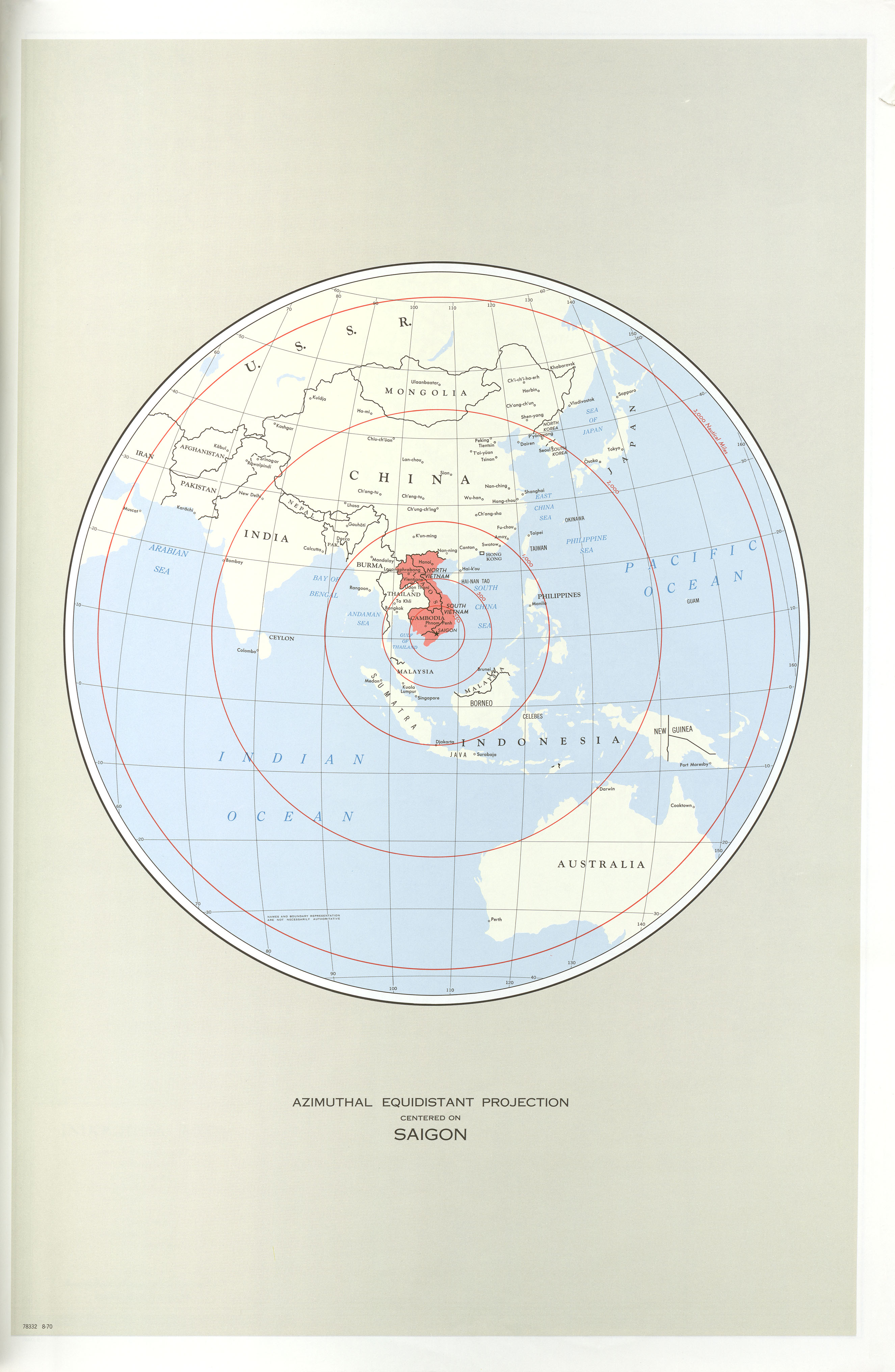
Wednesday, July 28, 1965: 'This ... is why we are in Vietnam'


President Johnson begins his news conference by announcing plans to increase U.S. troops in the Vietnam War from 75,000 to 125,000, along with doubling the monthly military draft quota from 17,000 to 35,000. He also lays out the reasons for America's increasing involvement, including this passage:

"We did not choose to be the guardians at the gate, but there is no one else. ... Three presidents -- President Eisenhower, President Kennedy, and your present president -- over 11 years have committed themselves and have promised to help defend this small and valiant nation. Strengthened by that promise,  the people of South Vietnam have fought for many long years. Thousands of them have died. Thousands more have been crippled and scarred by war. We just cannot now dishonor our word, or abandon our commitment, or leave those who believed us and who trusted us to the terror and repression and murder that would follow. This, then, my fellow Americans, is why we are in Vietnam." 

Johnson concludes with these words: "... as long as there are men who hate and destroy, we must have the courage to resist, or we will see it all, all that we have built, all that we hope to build, all of our dreams for freedom -- all, all will be swept away on the flood of conquest. So, too, this shall not happen. We will stand in Vietnam."

-- Map detail from "Azimuthal Equidistant Projection Centered on Saigon" (CIA, 1965): @

Resources
* Transcript (from "Public Papers of the Presidents of the United States"): @
* Video & audio (Miller Center, University of Virginia): @
* "Build-Up in Viet Nam" (Toledo Blade, July 25, 1965): @
* "President Doubles Draft Call" (United Press International, July 28, 1965): @
* "LBJ Hikes Draft for Viet Nam War" (Associated Press, July 29): @
* "Johnson Tells Why Vietnam in Pamphlet" (Associated Press, August 24): @
* "Why Viet-Nam" (Department of Defense, 1965; includes remarks from Johnson's news conference; from Internet Archive): @
* "Johnson's Escalation of Vietnam: A Timeline" (Bill Moyers Journal, 2009): @ 
* Excerpt from "Presidents and Protestors: Political Rhetoric in the 1960s" (Theodore Windt, 1990): @
* "McNamara, Clifford, and the Burdens of Vietnam" (Secretaries of Defense Historical Series, 2011): @
* Pentagon Papers (National Archives, 1969): @ 

7.16.2015

Friday, July 16, 1965: The Southern Courier


The Southern Courier was established in 1965 by college students and recent graduates to cover the civil rights movement and President Lyndon Johnson's War on Poverty in the American South. Despite the paper's small size and relatively short publication life, The Southern Courier fulfilled an important and sorely needed role in the post-1965 South by providing African Americans and sympathetic whites with a broader sense of community in the fight for equality. The Southern Courier offered a more complex view of race relations to the general public.
     -- From Encyclopedia of Alabama (full summary: @)

* Southern Courier site (includes links to PDFs of every issue): @
* Jim Peppler Southern Courier Photograph Collection (Alabama Department of Archives and History): @
* Summary from Veterans of the Civil Rights Movement: @
* "A Personal Historian's Memories of the American Civil Rights Era: Birmingham Alabama 1967" (Joan Tornow, 2015): @
* "Civil Rights: Student Editors from Harvard Plan an Independent Newspaper" (Nashua Telegraph, May 5, 1965): @
* "New Civil Rights Paper Covers Southern Issues" (The Michigan Daily, July 1, 1965): @
* "The Southern Courier: A Study of Civil Rights Journalism in Alabama" (Nieman Reports, December 1966, page 15): @
* Excerpt from "Fighting the Devil in Dixie: How Civil Rights Activists Took On the Ku Klux Klan" (Wayne Greenhaw, 2011): @ 

5.23.2015

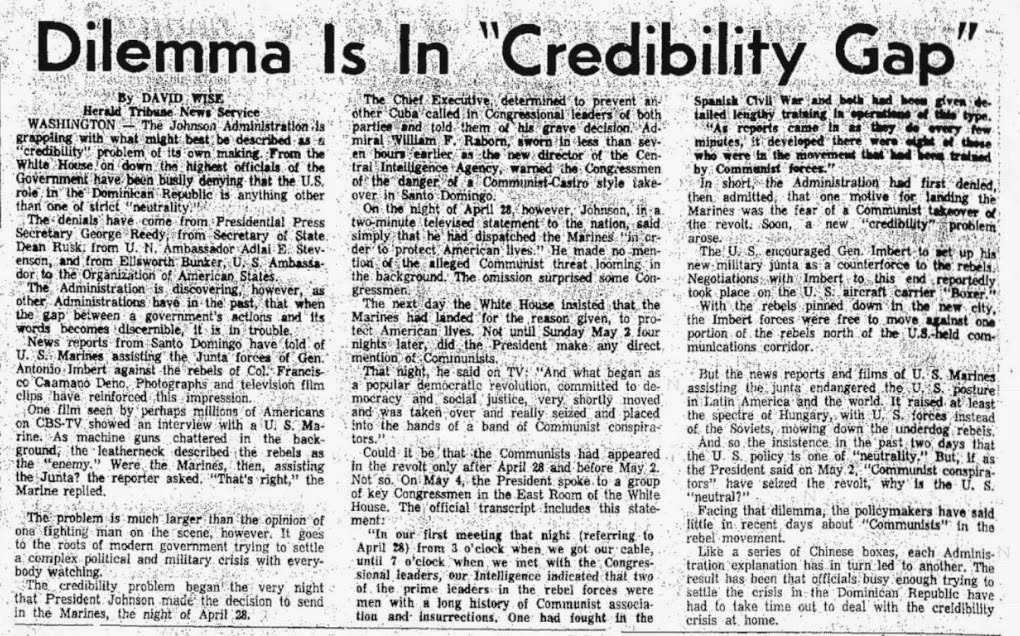
Sunday, May 23, 1965: 'Credibility gap'


The term -- referring to the disparity between the stated justification and the actual reason for U.S. military intervention in the Dominican Republic -- appears as part of a column written by David Wise of the New York Herald Tribune. Wise does not use those exact words; instead, it appears in the headline "Dilemma in 'Credibility Gap.' "  
     -- Clipping from The High Point (N.C.) Enterprise, May 28, 1965

(A May 1 message from Gen. Earle G. Weaver, chairman of the Joint Chiefs of Staff, to Lt.  Gen. Bruce Palmer Jr., commander of the U.S. forces in the Dominican Republic, summarizes the narratives: "Your announced mission is to save US lives. Your unannounced mission is to prevent the Dominican Republic from going Communist.")
     -- Source: "Foreign Relations of the United States, 1964-1968": @)

     The term gains wider use after Murrey Marder's story in The Washington Post in December 1965: "Creeping signs of doubt and cynicism about administration pronouncements, especially in its foreign policy, are privately troubling some of the government's usually stalwart supporters. The problem could be called a credibility gap. It represents a perceptibly growing disquiet, misgiving or skepticism about the candor or validity of official declarations."
     -- "Doubt Grows Over Administration Statements," as published in the (Mansfield, Ohio) News-Journal, December 7, 1965 (via newspapers.com; subscription only): @

     The term would become closely associated with the Johnson administration's conduct of the Vietnam War, as well as with the words and actions of politicians in general.

Resources
* Entry from "Encyclopedia of American Journalism" (edited by Stephen L. Vaughn, 2008): @
* Entry from "Safire's Political Dictionary" (William Safire, 2008): @
* Entry from "Historical Dictionary of the 1970s" (edited by James S. Olson, 1999): @
* Entry from "History of the Mass Media in the United States: An Encyclopedia" (edited by Margaret A. Blanchard, 1998): @
* "Credibility Gap -- Part 1" (Walter Lippman, March 1967): @
* "Credibility Gap -- Part 2" (Lippman, April 1967): @
* "The Dominican Crisis ... The Hemisphere Acts" (U.S. State Department, October 1965): @
* "Congress, Information and Foreign Affairs" (Prepared for the Senate Committee on Foreign Relations by the Foreign Affairs and National Defense Division, Congressional Research Service, Library of Congress, 1978): @
* "When Presidents Lie: A History of Official Deception and Its Consequences" (Eric Alterman, 2004): @
* "McNamara, Clifford, and the Burdens of Vietnam, 1965-1969" (Edward J. Drea, Historical Office, Office of the Secretary of Defense, 2011): @ 

5.18.2015

Tuesday, May 18, 1965: Head Start


WASHINGTON -- President Johnson said Tuesday 530,000 of "poverty's children" will be given a head start in pre-school guidance centers so they won't already be doomed to fail because of family backgrounds when they start school. More than half the estimated one million disadvantaged children expected to start school next fall will take part in the first summer sessions of Project Head Start. ... The program calls for teaching the children things that most people take for granted. Some of the children have never seen a book, a flush toilet or electric lights. They also will receive medical and dental care.
     -- From Associated Press story: @
     -- 1965 photo, Buffalo, New York, by Milton Rogovin; from Library of Congress

* Johnson's remarks (American Presidency Project): @
* "U.S. Program for Children Set to Begin" (Associated Press, May 18): @
* Office of Head Start, Department of Health and Human Services: @
* National Head Start Association: @
* "Timeline: Head Start's Journey" (Education Week): @
* "Head Start: The War on Poverty goes to school" (EducationNext): @
* "Project Head Start to Help Needy Pre-School Children" (New York Times, March 9, 1965): @
* "Project 'Head Start' Helps Negro Tots" (Jet magazine, June 17, 1965): @
* "Let's Make 'Head Start' Regular Start" (Ebony magazine, September 1965): @
* "Operation Head Start" (1965 video by Goldsholl Associations for Chicago Public Schools; from Chicago Film Archives): @
* "Head Start" (1966 video, Office of Economic Opportunity; from www.criticalpast.com): @
* "Operation Head Start" (1967 video by Paul Burnford Productions for Office of Economic Opportunity): @
* "An Evaluation of Operation Head Start Bilingual Children, Summer, 1965" (Philip Montez, Foundation for Mexican-American Studies, August 1966): @ 
* "Head Start: The Inside Story of America's Most Successful Educational Experiment" (Edward Zigler and Susan Muenchow, 1992): @
* "Project Head Start: Models and Strategies for the Twenty-First Century" (Valora Washington and Ura Jean Oyemade Bailey, 1995): @
* "Critical Perspectives on Project Head Start" (edited by Jeanne Ellsworth and Lynda J. Ames, 1998): @
* "The Birth of Head Start: Preschool Education Policies in the Kennedy and Johnson Administrations" (Maris A. Vinovskis, 2005): @
* "Launching the War on Poverty: An Oral History" (Michael L. Gillette, 2010): @
* "The War on Poverty: A New Grassroots History" (edited by Annelise Orleck and Lisa Gayle Hazirjian, 2011): @
* "Head Start Origins and Impacts" (Chloe Gibbs, Jens Ludwig and Douglas L. Miller, from "Legacies of the War on Poverty," 2013): @ 

4.22.2015

1965: LBJ's Amphicar


     Built in Germany from 1961 to 1968, the Amphicar is the only civilian amphibious passenger automobile ever to be mass produced. A total of 3,878 vehicles were produced in four colors: Beach White, Regatta Red, Fjord Green (Aqua) and Lagoon Blue -- the color of President Johnson's Amphicar. President Johnson enjoyed surprising unsuspecting guests when taking them for a ride in his Amphicar.
     "The President, with Vicky McCammon in the seat alongside him and me in the back, was now driving around in a small blue car with the top down. We reached a steep incline at the edge of the lake and the car started rolling rapidly toward the water. The President shouted, 'The brakes don't work! The brakes won't hold! We're going in! We're going under!' The car splashed into the water. I started to get out. Just then the car leveled and I realized we were in an Amphicar. The President laughed. As we putted along the lake then (and throughout the evening), he teased me. 'Vicky, did you see what Joe did? He didn't give a damn about his President. He just wanted to save his own skin and get out of the car.' Then he'd roar." -- Joseph A. Califano Jr. (special assistant to Johnson, 1965-1969).

     -- Text from "Presidential Vehicles" (Lyndon B. Johnson National Historical Park): @
     -- Photo from LBJ Library, dated April 10, 1965; passengers are Eunice Kennedy Shriver and Paul Glynn; photo by Yoichi Okamoto 

* "LBJ's Amphibious Car" (footage from LBJ Library): @
* "Remembering Amphicar, the swim-utility vehicle" (BBC, 2015): @
* "I Drove Through a Flood in a Car That 'Swims' " (Popular Science, August 1967): @
* "The Amphicar: What It's Like to Drive" (Popular Science, July 1960): @ 
* The International Amphicar Owner's Club: @
* www.amphicars.com: @
* www.amphicarbroker.com: @
* Amphicar forums: @ 

Blog archive

Twitter

Follow: @