Showing posts with label military. Show all posts

10.15.2015

Friday, October 15, 1965: David Miller burns his draft card


Tuesday, August 31
President Johnson signed into law Tuesday legislation to prohibit the destruction of draft cards. The measure is an outgrowth of student protests against U.S. policy in Viet Nam. The bill, introduced by Rep. L. Mendel Rivers, D-S.C., was rushed through Congress following reports persons had burned or ripped up their draft cards in protest against the Viet Nam War. The new law makes any person found guilty of destroying the wallet-size Selective Service cards subject to a $10,000 fine or a five-year prison term. Alteration and forgery of drafts cards already is a federal offense, punishable by fines of up to $10,000 and jail terms of up to five years.
     -- United Press International; full text of law (Government Printing Office): @

Friday, October 15
At an anti-war rally in New York, David Miller burns his draft card. Miller would be arrested three days later, becoming the first person charged under the new law. (After a lengthy court battle, he would serve 22 months in federal prison starting in June 1968.)
     -- Photo from Corbis Images

* "Memoirs of a Draft-Card Burner" (Miller, 2002): @
* "Draft Card Burner Arrested by F.B.I." (October 18, 1965): @
* "A Serious To-Do About a Silly Law" (Loudon Wainwright, Life magazine, March 4, 1966): @
* "Card Burner Raps Penalty" (Associated Press, March 15, 1966): @
* United States v. Miller (decided October 13, 1966; from Casetext): @
* "Appeal Rejected by High Court" (UPI, February 13, 1967): @
* "Draft Card Burner Nears 'High Noon' " (Washington Post, July 1967): @
* United States v. O'Brien (decided May 27, 1968; from FindLaw): @
* "Reflections of a Draft Card Burner" (Newspaper Enterprise Association, March 1972): @
* "Confronting the War Machine: Draft Resistance During the Vietnam War" (Michael S. Foley, 2003): @
* Entry from "Encyclopedia of American Civil Liberties" (2006): @
* "America's Army: Making the All-Volunteer Force" (Beth L. Bailey, 2009): @ 
* Entry from "Civil Disobedience: An Encyclopedic History of Dissidence in the United States" (2015): @

8.11.2015

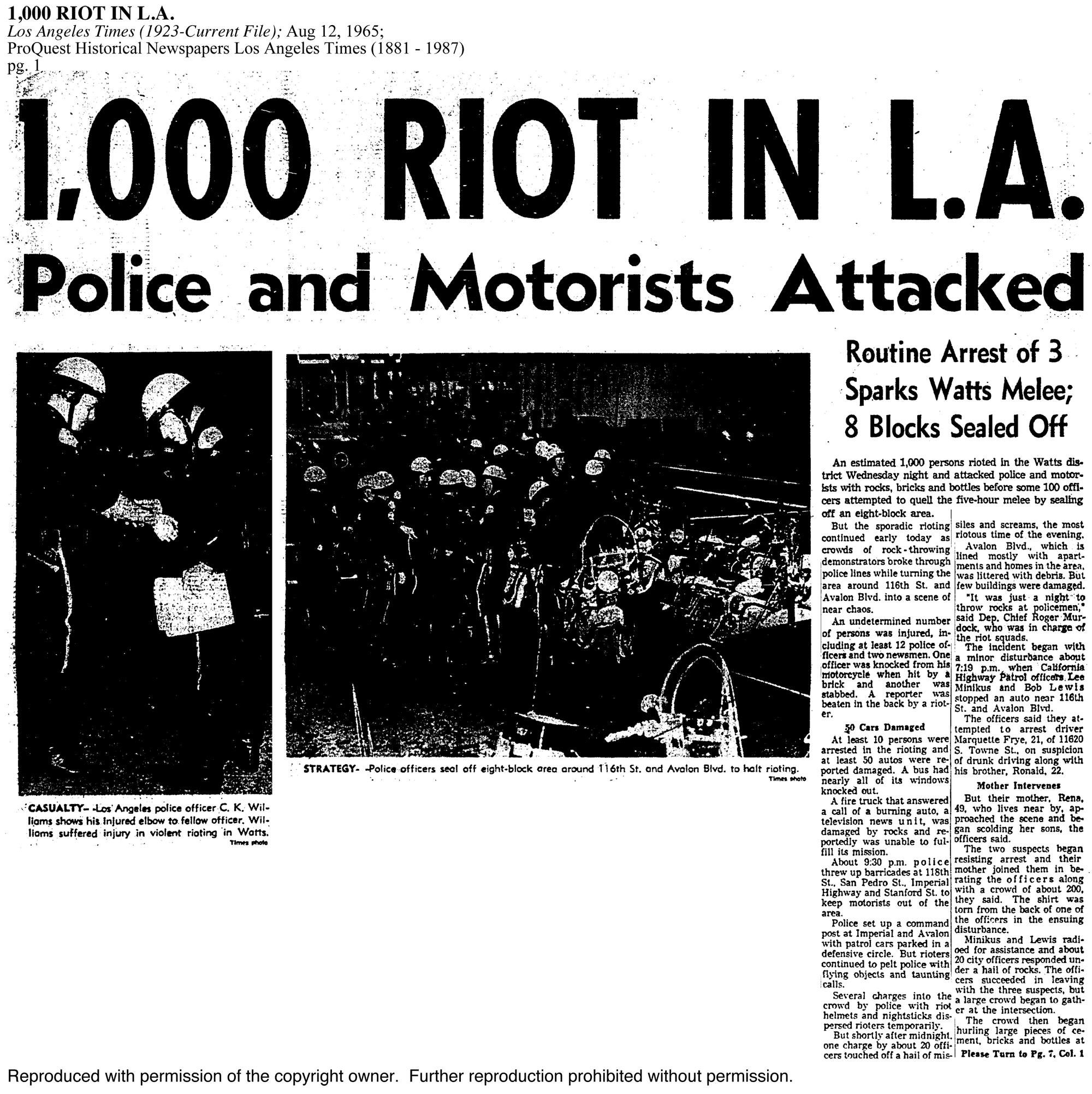
Wednesday, August 11, 1965: Watts riots begin


Wednesday, August 11
     An estimated 1,000 persons rioted in the Watts district Wednesday night and attacked police and motorists with rocks, bricks and bottles before some 100 officers attempted to quell the five-hour melee by sealing off an eight-block area. ...
     The incident began with a minor disturbance about 7:19 p.m. when California Highway Patrol officers Lee Minikus and Bob Lewis stopped an auto near 116th St. and Avalon Blvd.
     The officers said they attempted to arrest driver Marquette Frye, 21, of 11620 S. Towne St., on suspicion of drunk driving along with his brother, Ronald, 22. 
     But their mother, Rena, 49, who lives near by, approached the scene and began scolding her sons, the officers said.
     The two suspects began resisting arrest and their mother joined them in berating the officers along with a crowd of about 200, they said. The shirt was torn from the back of one of the officers in the ensuing disturbance.
     Minikus and Lewis and radioed for assistance and about 20 city officers responded under a hail of rocks. The officers succeeded in leaving with the three suspects, but a large crowd began to gather at the intersection.
     -- Los Angeles Times: @ 

Thursday, August 12
     Fierce rioting again gripped the Negro section of south Los Angeles tonight. Officials called it the worst racial incident in the city's history.
     Crowds of up to 5,000 Negroes gathered in a 20-block area that had been sealed off by some 100 policemen and more than 300 deputy sheriffs. ...
     Officials were at a loss to explain the cause of the rioting, which started last night after a routine drunken driving arrest. The unusually hot, smoggy weather was doubtless a contributing factor.
     Many Negroes at the scene complained about alleged police brutality but few cited specific instances to support their charges.
     -- New York Times: @ 

Friday, August 13
     National Guardsmen with fixed bayonets marched Friday night into a Negro district where arsonists and looters were out of control and flying bullets killed both police and civilians.
     Four persons, one a deputy sheriff, were reported slain by gunshot just before the first wave of 400 steel-helmeted troops rolled into the community of Watts and quickly took over without incident.
     The area, focal point of rioting for two days, was quiet when guardsmen arrived. All the action was farther north where thousands of Negroes raced through darkness breaking into stores, looting them and igniting many.
     -- Associated Press: @

Saturday, August 14
     The nation's worst Negro uprising in two decades was crushed Saturday by 2,000 rifle-carrying National Guardsmen and armed police but sporadic violence and nearly uncontrolled looting went on throughout the area.
     At least 17 persons were killed, a thousand arrested and "astronomical" damage in the millions was caused in the three days of rioting.
     Police cautioned store owners not to risk lives by defending their property as devastated supermarkets, department stores and shops became targets again for ransacking when troops pulled back to bivouacs. Police rounded up the looters as fast as they could catch them.
     -- United Press International: @
     -- Timeline, Wednesday-Saturday (Australian Associated Press): @ 

Sunday, August 15
     A vast military maneuver Sunday seized, occupied and almost completely controlled a Negro district wracked by five days' violence. But a police officer was shot to death as rampaging Negro mobs carried violence to other areas.
     -- Associated Press: @

Monday, August 16
     Comparative calm settled over the city's troop-encircled Negro riot zone today after a wild night in which violence spread for the first time to other Southern California cities. ...
     After five straight nights of rioting by uncounted thousands of Negroes, police removed most of the barricades in a 42-square-mile "unsafe" zone and this morning residents moved about freely for the first time since Wednesday night.
     -- Associated Press: @ 

Tuesday, August 17
     Violence dwindled today in Los Angeles' vast Negro district after six days of rioting which evangelist Billy Graham called "a dress rehearsal for a revolution." ...
     Courts processed the first of more than 3,000 suspected rioters arrested.
     Food markets opened and clears, wearing pistols, sold food as troops stood guard.
     City and county offices were opened, buses rolled again, mail delivery was resumed, and clean-up crew tackled wreckage left by six days of turmoil.
     Gov. Edmund G. Brown declared the riots ended.
     But 15,000 National Guardsmen still held the 46-square-mile heart of the Los Angeles Negro district sealed within a perimeter of guns.
     -- Associated Press: @

Wednesday, August 18
     Police and National Guardsmen today unleashed a barrage of gunfire into a Black Muslim mosque in the heart of a Negro neighborhood where weeklong rioting had been declared ended. 
     Officers opened up with pistols, rifles and shotguns after several heavily-armed Negroes were reported to have entered the building and fired on police. Eight Negroes suffered head injuries in scuffling with police who charged into the temple.
     -- United Press International: @

Other resources
* "Violence in the City: An End or a Beginning? / A Report by the Governor's Commission on the Los Angeles Riots" (December 1965): @
* Summary from www.findingdulcinea.com: @
* Summary from www.blackpast.org: @
* Summary from Civil Rights Digital Library: @
* Summary from "Encyclopedia of Political Communication" (edited by Lynda Lee Kaid and Christina Holtz-Bacha, 2008): @
* "Watts Annotations" (Los Angeles Times): @
* KTLA audio, August 13, 1965 (pastdaily.com): @
* Life magazine, August 27, 1965: @
* Jet magazine, September 2, 1965: @
* Ebony magazine, October 1965: @
* Newsreel: @ 
* "There's Still Hell to Pay in Watts" (Life magazine, July 15, 1966; excerpt from "Burn, Baby, Burn!," Jerry Cohen and William S. Murphy): @
* Origins of "Burn, Baby! Burn!" (www.magnificentmontague.com): @
* Radio interview with Magnificent Montague (Public Radio Exchange, 2009): @
* "Report Takes Myth Out of That Watts Rioting" (United Press International, September 1, 1966): @
* "A Stranger in the City" (Robert Conot, 1967; from "Perspectives on Black America," 1970): @
* Marquette Frye obituary (Los Angeles Times; 1986): @
* Rena Price obituary (Los Angeles Times; 2013): @
* "Watts Riots Changed the Black Movement for Years Afterward" (United Press International, August 1990): @
* "Fire This Time: The Watts Uprising and the 1960s" (Gerald Horne, 1995): @
* "Burn Baby Burn: Small Business in the Urban Riots of the 1960s" (Jonathan J. Bean, Independent Review, 2000): @
* "Watts Riots, 40 Years Later" (Los Angeles Times, August 11, 2005): @
* "Troubled Pasts: News and the Collective Memory of Social Unrest" (Jill A. Edy, 2006): @ 

8.05.2015

Thursday, August 5, 1965: CBS report on Cam Ne, South Vietnam


CBS airs Morley Safer's report on U.S. Marines setting fire to houses in Cam Ne, a village southwest of Da Nang Air Base in South Vietnam. Reaction ranges from unease to outrage (by viewers angry at CBS, as well as by President Johnson in a blistering phone call to CBS President Frank Stanton). The report is considered a milestone moment in media coverage of the Vietnam War.
     -- The incident at Cam Ne took place on August 3, while Safer's report aired on August 5. The story at top appeared August 3 in the Logansport (Indiana) Pharos-Tribune; the photo ran August 7 in The La Crosse (Wisconsin) Tribune.

* Watch the segment (CBS News): @
* Video interview with Safer (Archive of American Television, 2000): @
* Account from Safer (from "Reporting America at War," PBS, 2003): @
* "Marines Ordered to Stop Burning Viet Nam Villages" (Los Angeles Times, August 23, 1965): @
* "What Really Happened at Cam Ne" (www.historynet.com, 2006): @
* "When The World Began Watching" (The Alicia Patterson Foundation, 2011): @
* "The Power and The Profits: Part II" (David Halberstam, The Atlantic magazine, February 1976): @
* "The Powers That Be" (Halberstam, 1975): @
* Video interview with Halberstam (WGBH, 1979): @
* "The 6:00 Follies: Hegemony, Television News, and the War of Attrition" (Elizabeth J. Burnette, American Studies at the University of Virginia, 2005): @
* Excerpt from "The Uncensored War: The Media and Vietnam" (Daniel C. Hallin, 1986): @
* Excerpt from "The Legacy: The Vietnam War in the American Imagination" (from chapter titled "Vietnam and the Press," Michael X. Delli Carpini; book edited by D. Michael Shafer, 1990): @
* Excerpt from "The Sixties: From Memory to History" (from chapter titled "And That's The Way It Was: The Vietnam War on the Network Nightly News," Chester J. Pach Jr.; book edited by David Farber, 1994): @
* "Excerpt from "The U.S. Government and the Vietnam War: Executive and Legislative Roles and Relationships, Part IV" (William C. Gibbons, 1995): @
* Excerpt from "The End of Victory Culture: Cold War America and the Disillusioning of a Generation" (Tom Engelhardt, 1995): @
* Excerpt from "Encyclopedia of Media and Propaganda in Wartime America" (edited by Martin J. Manning and Clarence R. Wyatt, 2011): @ 

7.28.2015

Wednesday, July 28, 1965: 'This ... is why we are in Vietnam'


President Johnson begins his news conference by announcing plans to increase U.S. troops in the Vietnam War from 75,000 to 125,000, along with doubling the monthly military draft quota from 17,000 to 35,000. He also lays out the reasons for America's increasing involvement, including this passage:

"We did not choose to be the guardians at the gate, but there is no one else. ... Three presidents -- President Eisenhower, President Kennedy, and your present president -- over 11 years have committed themselves and have promised to help defend this small and valiant nation. Strengthened by that promise,  the people of South Vietnam have fought for many long years. Thousands of them have died. Thousands more have been crippled and scarred by war. We just cannot now dishonor our word, or abandon our commitment, or leave those who believed us and who trusted us to the terror and repression and murder that would follow. This, then, my fellow Americans, is why we are in Vietnam." 

Johnson concludes with these words: "... as long as there are men who hate and destroy, we must have the courage to resist, or we will see it all, all that we have built, all that we hope to build, all of our dreams for freedom -- all, all will be swept away on the flood of conquest. So, too, this shall not happen. We will stand in Vietnam."

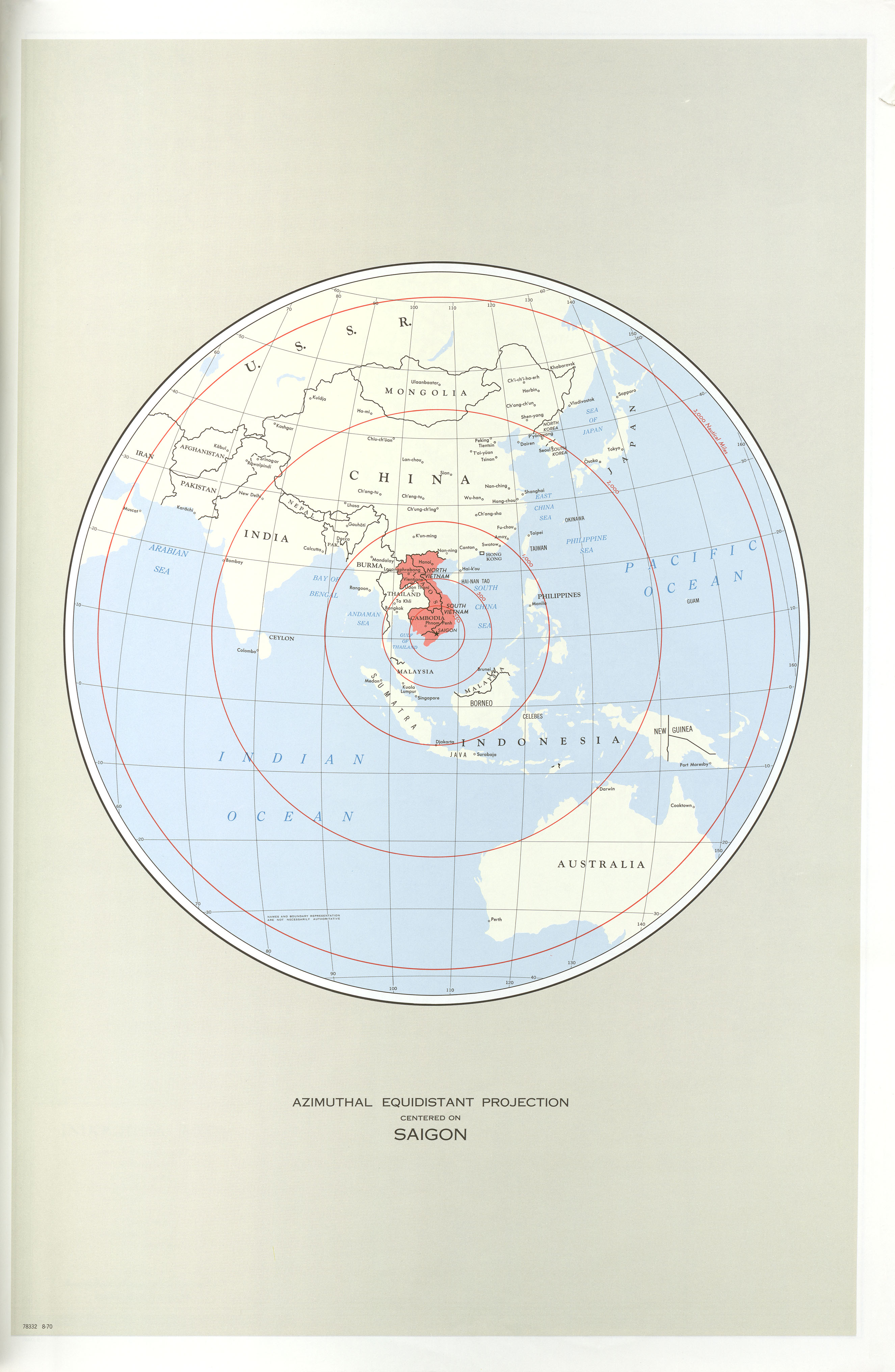
-- Map detail from "Azimuthal Equidistant Projection Centered on Saigon" (CIA, 1965): @

Resources
* Transcript (from "Public Papers of the Presidents of the United States"): @
* Video & audio (Miller Center, University of Virginia): @
* "Build-Up in Viet Nam" (Toledo Blade, July 25, 1965): @
* "President Doubles Draft Call" (United Press International, July 28, 1965): @
* "LBJ Hikes Draft for Viet Nam War" (Associated Press, July 29): @
* "Johnson Tells Why Vietnam in Pamphlet" (Associated Press, August 24): @
* "Why Viet-Nam" (Department of Defense, 1965; includes remarks from Johnson's news conference; from Internet Archive): @
* "Johnson's Escalation of Vietnam: A Timeline" (Bill Moyers Journal, 2009): @ 
* Excerpt from "Presidents and Protestors: Political Rhetoric in the 1960s" (Theodore Windt, 1990): @
* "McNamara, Clifford, and the Burdens of Vietnam" (Secretaries of Defense Historical Series, 2011): @
* Pentagon Papers (National Archives, 1969): @ 

6.18.2015

Friday, June 18, 1965: 'War is Hell'


Place: South Vietnam
Photographer: Horst Faas
Original caption (from The Associated Press): An unidentified U.S. Army personnel wears a hand-lettered "War Is Hell" slogan on his helmet June 18, 1965, during the Vietnam War. He was with the 173rd Airborne Brigade battalion on defense duty at Phuoc Vinh airstrip in South Vietnam.


The earliest publication date I can find is from July 23, 1967 in various newspapers as part of a story and a block of photos on soldiers' helmets. Caption: That old American individualism comes out even in the jungles of South Vietnam, as the above pictures show. Hats definitely are in fashion when the bullets fly -- and the fashions are as varied as the ingenuity of the GIs. Some are functional -- such as the extra machine gun ammunition around a machine gunner's hat, top left; some are expressive -- such as the "war is hell" band at top center; some are poignant -- like the helmet liner marked off for every day of the wearer's tour in bottom left; and some are nostalgic, such as the helmet featuring the snapshot in bottom center.

Note: In June 2012, the soldier was identified as Larry Wayne Chaffin, who served in 1965-66 (from The Southern Illinoisian: @). 

Horst Faas' Vietnam photos
* From The Denver Post: @
* From The Associated Press: @


Origins of phrase 'War is hell' (General William T. Sherman)
     -- Image from Ohio State Journal, August 12, 1880, on Sherman's speech the day before.
* From "Sherman: A Soldier's Passion for Order" (John F. Marsalek, 2007): @
* From "The Oxford Dictionary of American Quotations" (2006): @
* From "Nashville: The Western Confederacy's Final Gamble" (James L. McDonough, 2004): @ 

2.27.2015

Saturday, February 27, 1965: Vietnam 'white paper'

The United States published a new "white paper" on Viet Nam today that charged North Viet Nam with waging an aggressive war against South Viet Nam as if it were an open invasion. ... An evident purpose of the report, too, is to lend support to the Johnson administration's policy of striking against targets in North Viet Nam. These bombings, undertaken three weeks ago, are expected to continue. ... The white paper was designed to show with precise figures the extent to which Viet Cong guerrillas in the south are supported and controlled by North Viet Nam. Thereby it sought to refute any suggestion that it is simply a civil war being fought in South Viet Nam.
     -- Associated Press (link to story: @)

* "Aggression From the North: The Record of North Viet-Nam's Campaign to Conquer South-Vietnam" (complete report; from The Vietnam Center and Archive, Texas Tech University): @ 

2.18.2015

Thursday, February 18, 1965: 'Grave but by no means hopeless'

Presenting the military budget to Congress, Secretary of Defense Robert McNamara states: "The present situation in South Viet Nam is grave but by no means hopeless." His words echo exactly those of Secretary of State John Foster Dulles in describing the situation in Indochina in 1954.

Dulles, June 4, 1954 (Associated Press story: @) 


* "The Threat of Direct Communist Chinese Intervention in Indochina" (Dulles, June 1954; from The Avalon Project, Yale Law School): @ 
* "The French Indochina War 1946-54" (Martin Windrow, 1998): @ 

McNamara, February 18, 1965 (Associated Press story: @)


* Full text of statement (from Department of Defense): @
* "Extracts of Statements by Robert S. McNamara on the Outlook in South Vietnam" (from The Harold Weisberg Archive): @
* "Leaders' Statements on Southeast Asia Examined" (Associated Press, February 21): @
* Excerpt from "Johnson's War/Johnson's Great Society: The Guns and Butter Trap" (Jeffrey W. Helsing, 2000): @ 

11.27.2014

Friday, November 27, 1964: Operation Moneybags

     British soldiers are given LSD as part of research into how the drug might affect their capabilities as well as military operations. From the Imperial War Museum's description of the filmed summary (link: @):
     Introductory title places trial in context of recent research to discover chemical agents able to incapacitate enemy forces but with negligible risk of fatal casualties. ... One Marine in state of distress is comforted by nurse, while others smile and laugh hysterically, one attempting to cut down a tree with his spade, and another climbing the tree. ... After exercise Marines rest in bed in Porton ward ... One very distressed Marine is held by duffel coated doctor and scientist, muttering "I am not going to die."  Cut back to end of the exercise, with Marines departing by truck, before concluding title states that despite promising results of experiment, further research is needed into methods of disseminating drug, the effects of larger doses and establishing economical production techniques. "Despite these and other problems, LSD is regarded in the light of present knowledge as one of the drugs which merits more detailed examination and testing."

* Short clip from film: @
* Excerpt from "Albion Dreaming: A Popular History of LSD in Britain" (Andy Roberts, 2012): @
* House of Commons communications (1995): @
* "Drugged and Duped" (Rob Evans, The Guardian newspaper, March 14, 2002): @
* "Weapons Against the Mind" (Dr. W.M. Hollyhock, New Scientist magazine, April 22, 1965): @ 

10.16.2014

Friday, October 16, 1964: China's first nuclear test

Communist China joined the world's atomic powers today with an announcement it has exploded its first bomb in the western region of China. The announcement, coming less than 24 hours after the ouster of Soviet Premier Nikita Khrushchev, was sure to raise China's Mao Tse-Tung's stature among world Communist leaders. The official New China news agency statement said only: "China exploded an atom bomb at 1500 hours on Oct. 16, 1964, and thereby conducted successfully its first nuclear test."
     -- Associated Press (full story: @)

* Story from New York Times: @
* Summary from CTBTO Preparatory Commission: @
* Summary from Federation of American Scientists: @
* Summary from Nuclear Threat Initiative: @
* Summary and links from The National Security Archive: @ 

3.26.2014

Thursday, March 26, 1964: Floyd James Thompson


An Air Force observation plane flown by Captain Richard L. Whitesides and by U.S. Army Special Forces co-pilot Captain Floyd J. Thompson is downed by small arms fire. Thompson, the longest held prisoner of war in American history, would not be released until 16 March 1973. 
-- From Vietnam War Commemoration (U.S. Department of Defense; link: @)
-- Photo from POW Network (link: @)

* Summary (from Task Force Omega): @
* Summary (from Veteran Tributes): @
* "Glory Denied: The Vietnam Saga of Jim Thompson, America's Longest-Held Prisoner of War" (Tom Philpott, 2001): @
* C-SPAN interview with Philpott (August 2001): @
* Obituary/tribute (Philpott, 2002; entered into Congressional Record): @
* Obituary (from New York Times, July 2002): @
* Obituary (from Los Angeles Times): @ 

11.01.2013

Friday-Saturday, November 1-2, 1963: Coup in South Vietnam

Ngo Dinh Diem, the president of South Vietnam, is shot and killed on November 2, the day after a military overthrow of the government began.


Clutched by searing flames, a Buddhist monk martyrs himself on a Saigon sidewalk. A few days later, joyous hands hoist a Vietnamese soldier in a victory that belongs both to him and the suicidal monk. Opposition to the regime of South Vietnam's President Ngo Dinh Diem had been gathering force like a thunderhead, overshadowing the U.S.-backed war against the Communist Viet Cong. First Buddhists, then students and other dissidents joined against Diem's government -- and the government had no answer but repressive brutality. Then Diem's own generals and the armies they command rose in revolt.

-- Life magazine, November 15, 1963 (link: @

-- Photo from Corbis Images. Original caption: In photo just obtained by UPI, the bodies of South Vietnamese President Ngo Dinh Diem (right) and his brother, Ngo Dinh Nhu, disguised as priests, lie in armored personnel carrier, November 2, shortly after they were slain in revolution. They were reportedly being taken to Army staff headquarters at Tan Son Nhut Airfield. Note bindings on Nhu's hands.

* Short summaries from history.com: @ and @
* Summary from "Vietnam War Almanac" (James H. Willbanks, 2009): @ 
* "Walkthrough: Vietnam in Late 1963" (from Mary Ferrell Foundation): @
* "South Vietnam 1963" (from "U.S. Foreign Policy in Perspective," David Sylvan and Stephen Majeski, 2009): @
* "JFK and the Diem Coup" (from National Security Archive): @
* "The Coup Against the Diem Government" (from "Foreign Relations of the United States," U.S. Department of State): @
* "Vietnam, August-December 1963" (from FRUS): @
* "The Overthrow of Ngo Dinh Diem, May-November, 1963" (from the Pentagon Papers, U.S. Department of Defense): @
* "The Vietnam Revolt" (newsreel): @
* "Death of a Regime" (CBS News): @
* "Vietnam Climax" (Life magazine, October 11): @ 

6.11.2013

Tuesday, June 11, 1963: The Stand in the Schoolhouse Door


ALABAMA ADMITS NEGRO STUDENTS;
WALLACE BOWS TO FEDERAL FORCE;
KENNEDY SEES 'MORAL CRISIS' IN U.S.

From The New York Times (link to full text below):

     TUSCALOOSA, Ala., June 11 -- Gov. George C. Wallace stepped aside today when confronted by federalized National Guard troops and permitted two Negroes to enroll in the University of Alabama. There was no violence.
     The Governor, flanked by state troopers, had staged a carefully planned show of defying a Federal Court desegregation order.
     Mr. Wallace refused four requests this morning from a Justice Department official that he allow Miss Vivian Malone and James A. Hood, both 20 years old to enter Foster Auditorium and register.
     This was in keeping with a campaign pledge that he would "stand in the schoolhouse door" to prevent a resumption of desegregation in Alabama's educational system.
     The official, Nicholas deB. Katzenbach, Deputy Attorney General, did not press the issue by bringing the students from a waiting car to face the Governor. Instead, they were taken to their dormitories.
     However, the outcome was foreshadowed even then. Mr. Katzenbach told Mr. Wallace during the confrontation:
     "From the outset, Governor, all of us have known that the final chapter of this history will be the admission of those students."
     Units of the 31st (Dixie) Division, federalized on orders from President Kennedy, arrived on the campus four and a half hours later under the command of Brig. Gen. Henry V. Graham.
     In a voice that was scarcely audible, General Graham said that it was his "sad duty" to order the Governor to step aside.
     Mr. Wallace then read the second of two statements challenging the constituionality of court-ordered desegregation and left the auditorium with his aides for Montgomery.
     Three minutes after their departure, Mr. Hood walked into the auditorium with Federal officials to register. Miss Malone followed a minute later.


Scowling, Gov. Wallace peers through the bars of an auditorium window as he stands like a sentinel awaiting pair's arrival. (Photo and caption from Jet magazine, June 27, 1963)


Malone and Hood enroll for classes.

* Summary from Encyclopedia of Alabama: @
* New York Times story: @
* "Alabama Story: Negroes Enrolled As Governor Yields" (newsreel, from criticalpast.com): @
* NBC footage: @
* "Wallace in the Schoolhouse Door" (NPR, 2003): @

* "Statement and Proclamation of Governor George C. Wallace" (signed by Wallace; from Alabama Department of Archives and History): @
* Separate copy of speech (from Samford University Library): @
* Telegrams to and from Wallace (from Alabama Department of Archives and History): @
* "Through the Doors: Courage. Change. Progress." (from University of Alabama): @
* "A Sleight of History: University of Alabama's Foster Auditorium" (from southernspaces.org): @
* "The Schoolhouse Door: Segregation's Last Stand at the University of Alabama" (E. Culpepper Clark, 1993): @
* "A Civil Rights Milestone, June 11, 1963" (C-SPAN video, 2008): @
* Resources from Civil Rights Digital Library: @


Note: On the night of June 11, President Kennedy spoke on TV and radio about the situation in Alabama and outlined his intention to press for civil rights legislation.
* Transcript and video (from Miller Center, University of Virginia): @
* Links to draft of speech and final version (from National Archives): @
* Telegram from the Rev. Martin Luther King Jr. to Kennedy after speech (from JFK Library): @ 

Blog archive

Twitter

Follow: @